Land value of Sydney home unlocks $1m working capital same day

  • Working capital required to fund a new opportunity for an architectural firm  
  • Loan backed by a residential asset with 60% LVR
  • Local valuers had a 15 business-day turnaround time in a peak period, when the borrower needed funds within 20 business days
  • Msquared Capital resolved valuation challenges same day


Clearing a valuation hurdle same day

NSW lending specialist Adrian Dracopoulos explains how Msquared Capital workshopped a solution same day that helped save a borrower thousands while meeting settlement deadlines.

We consider more property

Msquared Capital takes a commercial approach to lending. We have one of the most diverse valuation panels in private lending with access to the names the big banks like to see.

Download lending guide

General information only and does not constitute financial, investment, or legal advice. Msquared Capital’s lending activities are limited to writing loans for business and/or investment purposes only. The consumer protections in the National Credit Code do not apply.

Developer cracks expose private credit fault line

A major developer in distress, billions in debt spread across the private credit market, and a wave of investor phone calls asking one question: am I exposed? Msquared Capital Co-Founder & Fund Manager Paul Miron explains the credit discipline behind Msquared Capital’s lending.

Over the past week there has been significant media coverage of a large Sydney property developer in distress, and of the private credit funds exposed to it. According to The Australian, more than 18 private credit funds have in excess of $3 billion in debt tied to the group. Predictably, investors have been calling to ask whether we have any exposure — and they are right to ask.

Investors should understand exactly what sits inside their portfolio — not just the headline return, but the type of debt they own and the risks that come with it. That is the real question this month’s article addresses.

“Msquared Capital has no lending exposure to the Bathla Group”

The current snapshot: a two-speed correction

On current data, national dwelling values are in a genuine correction. Our base case is a peak-to-trough fall of around 10%, but the national average hides what is happening at the extremes: some segments and geographies will correct considerably harder — beyond 15% — while others are merely braking1.

The auction clearance rate is the truest leading indicator, and it has been sitting below 50% in Sydney and Melbourne since late May. That is not softness. That is a correction the aggregate data now confirms.

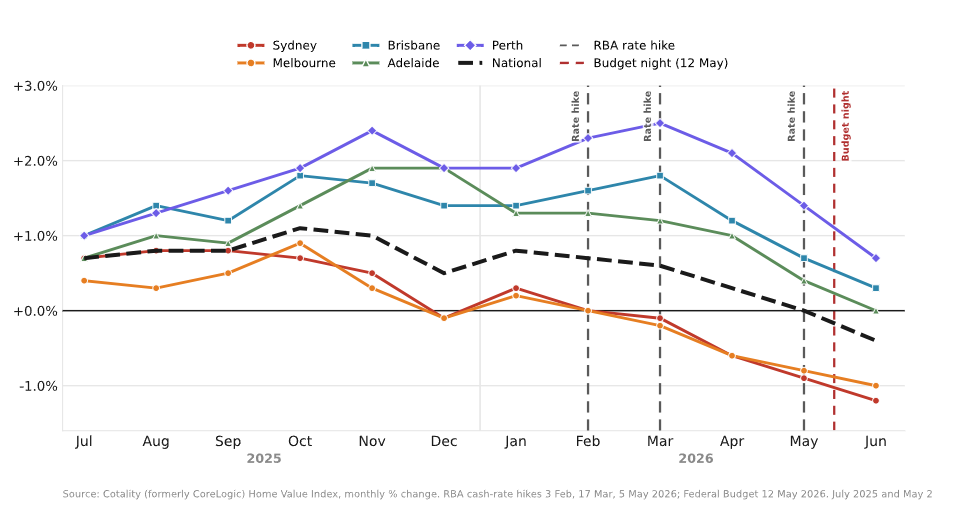
Over the past year the split has become unmistakable. Sydney and Melbourne have rolled from solid gains into accelerating monthly falls (-1.2% and -1.0% in June). The mid-sized capital cities that led the boom — Perth, Brisbane, Adelaide — peaked around the turn of the year and are now decelerating hard from monthly gains above 2% toward flat.

The first chart below tracks all five mainland capital cities month by month, with the RBA’s three 2026 cash-rate hikes and the 12 May federal budget marked: Sydney and Melbourne accelerated lower through precisely that window. The correction is real, but it is not uniform, and that distinction matters enormously for anyone lending against property2,3.

Chart: Monthly dwelling change by capital city, July 2025 – June 2026


Based on Cotality Home Value Index, monthly % change by capital city, July 2025 – June 2026.

The deterioration in both the economy and property began early this year — the product of sticky inflation, higher interest rates and excess government spending. Post-budget, that deterioration has accelerated, draining confidence from the market. Housing remains the single largest contributor to inflation, running at 6.5% over the year. Advertised rents are still climbing against sub-2% vacancy, and while the official CPI rent measure has eased to 3.6%, that lagging series has yet to catch up to what new tenants are paying — so the pressure on the very renters this budget claimed to help is still in the pipeline3,4,5.

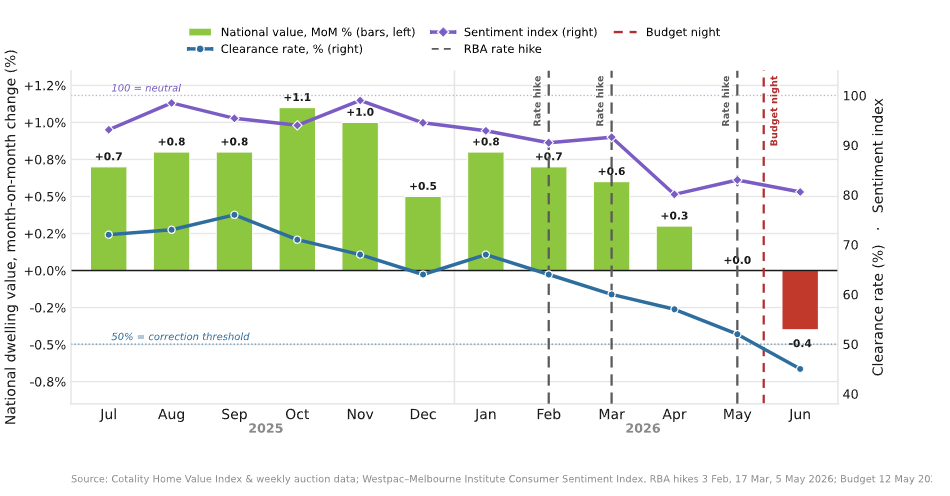
Crucially, none of this arrived without warning. The two most reliable leading indicators — consumer sentiment and auction clearance rates — both rolled over months before dwelling values turned negative. The second chart makes the sequence plain: national values sit as bars, with clearance rates and consumer sentiment overlaid as lines, and the three cash-rate hikes (February, March and May) and budget night marked.

Sentiment was already mired in deeply pessimistic territory and slid to a two-and-a-half-year low well before February’s first hike; clearance rates fell through 60% in March and below the 50% mark that historically signals sustained falls by late May. National values only tipped negative in June — just after the third hike and the budget landed together in May. Prices were the last domino, not the first6.

Chart: National prices vs auction clearances and consumer sentiment, July 2025 – June 2026

National dwelling value change (bars) against auction clearance rates and consumer sentiment (lines), July 2025 – June 2026. Sources: Cotality (formerly CoreLogic) Home Value Index — dwelling values, and weekly auction data — clearance rates (shown as monthly combined-capitals approximations); Westpac–Melbourne Institute Consumer Sentiment Index (100 = neutral). RBA cash-rate rises (3 Feb, 17 Mar, 5 May 2026) and the Federal Budget (12 May 2026) as marked.

Why is it going so wrong, so quickly?

We were presented with a budget supposedly designed to fix the housing crisis and inequality. Its own papers show otherwise. The strategy was to dampen investor demand — investors transact around 40% of the market — in order to push prices down and call the result affordability, while offering nothing on the supply side.

The consequence is that the velocity of money and property transactions is falling off a cliff. That hits two groups hardest: property developers and state governments. Fewer sales mean less stamp duty, less business activity, and less of the revenue base that funds schools, hospitals and roads. Property in Australia is both the heart and the glue of the economy — and all of this is being done while raising taxes on the businesses that collectively employ five million people. The unintended consequence, in my view, is a catalyst that materially raises the risk of recession over the next two years.

Where this becomes a nightmare — and where the real risk sits

For a developer, a few months of slowing sales starves the cash flow needed to service interest, pay staff and buy materials. Margins were already thin; as prices fall and sales stall, debt can end up exceeding the value of the asset. That is a developer solvency problem, and it happens in every cycle. It is being reported as a private credit problem.

The distinction that matters is within secured private credit. In a traditional loan, security is a recovery mechanism: if the borrower defaults, you realise the asset and recover your capital and interest. A development loan layers on two additional risks — construction risk (cost escalation, the builder failing, supply chain) and construction specific market risk (relying on an end product selling at a price assumed years earlier). Right now both are moving against borrowers at once: higher build costs meeting softer end values.

This is the inherent risk of construction and development lending, and too often it is not priced in. As investors, allocators and advisers have chased higher returns, they have placed less emphasis on the type of loans sitting inside pooled funds. We had the warnings — the Adgemis collapse, and ASIC flagging its concern about private credit exposure to speculative real estate. The market was largely unfazed7.

Our long-standing investors have heard me say it hundreds of times before:

“There would come a day when the front page of the AFR carried a large developer collapse and losses on speculative construction and second-mortgage lending”.

Concentration risk is an issue

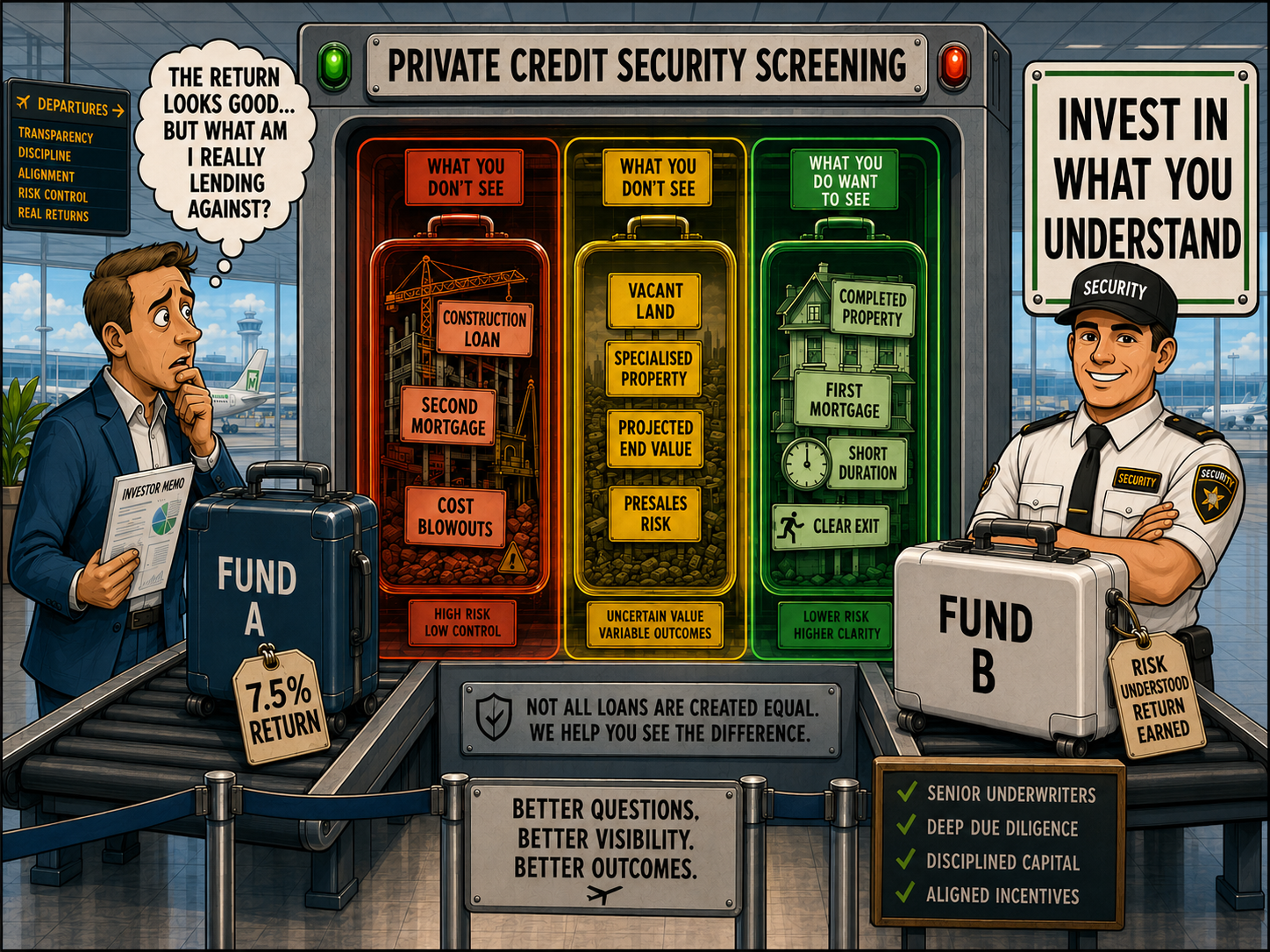
Concentration risk, investor perception and understanding of risk is the most important issue. What matters for investors is what actually sits beneath the label “private credit.” Lending to fund construction and development is a fundamentally different exposure to short-term business lending secured by completed property.

The former depends on a project being built and then sold at a price assumed years earlier; the latter is serviced from a borrower’s cash flow, with completed property as security. Both can be done well, but they do not carry the same risk — and a fund heavily concentrated in a single developer, or a single type of loan, can behave very differently when the cycle turns.

The lesson is a simple one, and it is the same one we have always put to investors: you should be able to see clearly what your capital is lending against, and understand how those structures are likely to behave under stress.

This is why the Msquared Mortgage Income Fund (MMIF)8 is built the way it is. Every loan is secured by a registered first-ranking mortgage over completed and established residential, commercial, retail or industrial real estate. The Fund does not lend for the construction or development of the security property, and does not lend against vacant land or a development project.

Borrowers are assessed on their character, cash flow and capacity to service the loan against a defined exit — because, as this cycle is making plain, servicing and exit matter as much as the security behind them.

We are not changing our approach, because the Fund was purpose-built for periods like this. What has changed is the opportunity set: as some lenders turn more cautious, well-secured short-term lending is, in our view, being priced more attractively.

So when an investor asks whether they are exposed to the next headline, our answer is the same as it has always been — ask your manager what you are lending against.

Disclaimer & sources

1 Property values are subject to a wide range of known and unknown risks, including but not limited to: changes in government policy and their impacts, interest rate movements, employment conditions, credit availability, and broader economic shocks. Actual outcomes may differ materially from any projections or ranges discussed.

2 Cotality, Monthly Housing Chart Pack — July 2026.

3 Reserve Bank of Australia, Cash Rate Target.

4 Australian Bureau of Statistics, Consumer Price Index, Australia, May 2026.

5 Cotality

6 Westpac–Melbourne Institute, Consumer Sentiment Bulletin, June 2026.

7 ASIC Report 814, Private credit in Australia (September 2025).

8 One Managed Investment Funds Limited ACN 117 400 987 AFSL 297042 (OIG) is responsible entity and issuer of units in Msquared Mortgage Income Fund ARSN 682 099 350 (MMIF or Fund). Msquared Capital Retail Funds Management Pty Ltd ACN 679 611 146 is the investment manager of MMIF (Manager). The Manager is a corporate authorised representative (no. 1312858) of One Investment Administration Ltd ACN 072 899 060 AFSL 225064 (OIAL) in respect of financial services provided to ‘retail clients’ (as defined in the Corporations Act) (Retail Clients). The Manager is also a corporate authorised representative (no. 1312533) of Msquared Capital Pty Ltd ACN 622 507 297 AFSL 520293 (Msquared Capital) in respect of financial services (including general financial product advice in relation to the Fund) provided to ‘wholesale clients’ only (as defined in the Corporations Act) (Wholesale Clients). The information provided on this website (Information) is general in nature and does not constitute investment or personal financial product advice, and does not take into account your investment objectives, particular needs or financial situation. You should seek independent financial advice. *Past performance is not a reliable indicator of future performance. The payment, specific rate of return and frequency of distributions are not guaranteed. Performance comparisons are provided purely for information purposes only and should not be relied upon. The Information may include information that is predictive in character which may be affected by inaccurate assumptions or by known or unknown risks and uncertainties and may differ materially from results ultimately achieved. Neither OIG, Msquared Capital, Manager nor any of their related entities guarantee the performance of the Fund or the repayment of any investor’s capital, and neither give any representation or warranty as to the reliability, completeness or accuracy of the Information and do not accept liability for any inaccurate, incomplete or omitted information or any losses caused by using this Information. Not an offer to invest. You should carefully consider the respective Fund’s disclosure documents, including Product Disclosure Statement (PDS) and Target Market Determination (TMD) for the MMIF before making any decision about whether to acquire, or continue to hold, an interest in the Fund. Applications for units in the Funds can only be made pursuant to the application form relevant to the Fund. The PDS and TMD can be obtained from www.msquaredcapital.com.au.

Msquared Capital Pty Ltd ACN 622 507 297 AFSL 520293. The information provided is general in nature and reflects the views of the author at the time of publication. Forward-looking information is inherently uncertain, and actual results may differ materially from projections. The information has been prepared without taking into account your objectives, financial situation or needs, and does not constitute personal financial product advice, investment advice or a recommendation. Not an offer to invest. Investments in the Fund’s products are not bank deposits and the performance of the Fund, return of capital or payment of distributions are not guaranteed. Before making any investment decision, you should consider whether the information is appropriate to your circumstances and seek independent financial advice.


Property downturn reveals private credit cracks

There are parts of the private credit market that will struggle over the next 12-24 months, predicts Msquared Capital’s Paul Miron. In his latest interview with Ausbiz, he says construction and development lending is particularly vulnerable to economic conditions and contagion risks. Budget measures continue to see turbulence in property valuations, while at the same time, debt-laden developers rely on constant property sales to sustain cash flow.

  • Msquared Capital predicts broad property price declines from their 2026 peak of at least 10%, with some segments down 15–20%
  • Construction and development lending is viewed as high risk amid rising costs and falling end values
  • Expects some private credit assets will be challenged for the next 12-24 months


Watch the interview with Ausbiz

Disclaimer

One Managed Investment Funds Limited ACN 117 400 987 AFSL 297042 (OIG) is responsible entity and issuer of units in Msquared Mortgage Income Fund ARSN 682 099 350 (MMIF or Fund). Msquared Capital Retail Funds Management Pty Ltd ACN 679 611 146 is the investment manager of MMIF (Manager). The Manager is a corporate authorised representative (no. 1312858) of One Investment Administration Ltd ACN 072 899 060 AFSL 225064 (OIAL) in respect of financial services provided to ‘retail clients’ (as defined in the Corporations Act) (Retail Clients). The Manager is also a corporate authorised representative (no. 1312533) of Msquared Capital Pty Ltd ACN 622 507 297 AFSL 520293 (Msquared Capital) in respect of financial services (including general financial product advice in relation to the Fund) provided to ‘wholesale clients’ only (as defined in the Corporations Act) (Wholesale Clients). The information provided on this website (Information) is general in nature and does not constitute investment or personal financial product advice, and does not take into account your investment objectives, particular needs or financial situation. You should seek independent financial advice.
*Past performance is not a reliable indicator of future performance. The payment, specific rate of return and frequency of distributions are not guaranteed. Performance comparisons are provided purely for information purposes only and should not be relied upon. The Information may include information that is predictive in character which may be affected by inaccurate assumptions or by known or unknown risks and uncertainties and may differ materially from results ultimately achieved. Neither OIG, Msquared Capital, Manager nor any of their related entities guarantee the performance of the Fund or the repayment of any investor’s capital, and neither give any representation or warranty as to the reliability, completeness or accuracy of the Information and do not accept liability for any inaccurate, incomplete or omitted information or any losses caused by using this Information. Not an offer to invest. You should carefully consider the respective Fund’s disclosure documents, including Product Disclosure Statement (PDS) and Target Market Determination (TMD) for the MMIF before making any decision about whether to acquire, or continue to hold, an interest in the Fund. Applications for units in the Funds can only be made pursuant to the application form relevant to the Fund.

Msquared Capital Pty Ltd ACN 622 507 297 AFSL 520293. The information provided is general in nature and reflects the views of the speaker at the time of recording. Forward-looking information is inherently uncertain, and actual results may differ materially from projections. The information has been prepared without taking into account your objectives, financial situation or needs, and does not constitute personal financial product advice, investment advice or a recommendation. Before making any investment decision, you should consider whether the information is appropriate to your circumstances and seek independent financial advice.

Property values are subject to a wide range of known and unknown risks, including but not limited to: changes in government policy and their impacts, interest rate movements, employment conditions, credit availability, and broader economic shocks. Actual outcomes may differ materially from any projections or ranges discussed.

Msquared Capital appoints new CCO following $1.5bn lending milestone

Msquared Capital has appointed a new chief commercial officer and expanded its origination team after surpassing $1.5 billion in commercial lending.

Written by Julian Barnes – Broker Daily

Michael Volkiene has been promoted from general manager – loan origination and credit to the newly created chief commercial officer (CCO) role.

A former Australia New Zealand Banking Group executive, he will oversee the firm’s product development strategy and investor and lending businesses.

Before joining Msquared Capital, Volkiene spent almost 20 years at ANZ, where he led a lending division focused on growing the bank’s broker channel.

The appointment comes as the private credit firm looks to expand its footprint, citing tighter bank lending criteria, growing demand for non-bank finance and a shortage of experienced credit professionals across the sector.

Co-founder Paul Myliotis said the business was continuing to invest in its people, distribution network and product offering.

“These appointments enhance our ability to scale while maintaining the lending quality our investors and borrowers expect,” he said.

Myliotis said Volkiene had played a key role in growing the firm’s lending business and expanding its broker distribution, with its products now available to around 70 per cent of brokers.

Volkiene said demand for private credit remained strong, particularly from businesses looking to unlock value from their real estate assets.

“These borrowers often require tailored solutions, and I’m excited by the opportunity to continue growing a business focused on delivering certainty in complex lending scenarios,” he said.

Msquared Capital said it currently sources capital through institutional mandates, managed funds for retail and wholesale investors, and its own balance sheet.

The firm has also appointed Michael Taipi to its Melbourne office to support brokers, with further appointments planned in Sydney and Brisbane.

Taipi previously owned and operated a mortgage broking business for more than 12 years.

Volkiene said Taipi’s experience as a broker would help strengthen the firm’s relationships with the third-party channel.

“Michael Taipi’s first-hand understanding of the broker journey, combined with extensive expertise in relationship management and commercial lending, gives him a unique perspective on what brokers need to succeed,” he said.

Disclaimer:

General information only and does not constitute financial, investment, or legal advice. Msquared Capital’s lending activities are limited to writing loans for business and/or investment purposes only. The consumer protections in the National Credit Code do not apply.

Robin Hood politics might break the economy

Australia’s housing crisis is entering a far more dangerous phase than most people realise warns Msquared Capital Co‑Founder & Fund Manager Paul Miron. He argues the government has accidentally engineered a supply freeze in the very part of the market where supply is most needed, with new tax settings hitting investors, tightening credit, and pushing rents higher. Measures may even push Australia’s future housing stock into the hands of offshore institutional capital.

For months, I have been one of the very few commentators openly stating what the data was already showing: property prices had already begun to fall. The auction clearance rate is the true indicator, and when it slips below 55% in Sydney and Melbourne for consecutive weeks, that is not a sign of softness — that is a correction. The aggregate data now confirms it.

Last week’s Cotality release (1 June 2026) puts the picture beyond debate. The national Home Value Index was flat (0.0%) in May, with Sydney down 0.9% and Melbourne down 0.8% — the two cities driving the downturn and absorbing the full weight of the Budget’s tax-side intervention. Matt Bell, chief economist at Oliver Hume Property Group, described the result as the moment the national housing market “came to a grinding halt.” ANZ has cut its national capital city forecast to 2.8% growth for the year, down from 4.8% in April. CBA has cut its forecast by nearly a third. In the top quartile of Sydney and Melbourne, prices have now fallen for five consecutive months.

So the Budget arrived at the worst possible time, with the wrong prescription, to treat a problem it fundamentally misunderstands.

The Treasurer, Jim Chalmers, has suggested, “If we are making it easier for first-home buyers to get a fair crack at auctions, then that’s a good thing.” The reality is more complicated.

Politicians are playing Russian Roulette with our economy. Driving property prices down does not just hand a discount to the first-home buyer — it hits the 1.4 million Australians the property sector employs, the 67% of household wealth tied to housing, and the state government revenue base that funds schools, hospitals and roads.

The government had a choice: increase Robin Hood taxes on property and business, or cut government spending, link migration growth to supply completions, and allow the free market to find its own efficiency. It chose the former.

Systemic risk, not sector problem

Property is not simply one investment class among many. It holds approximately 67% of all Australian household wealth and contributes roughly 10.6% to GDP directly, and up to 15% when flow-on effects are included. It employs over 1.4 million Australians across construction, sales, finance, and related industries — almost five times the direct employment of the mining sector, which so often monopolises the national conversation. Property pays more tax to federal and state coffers than mining. It is the engine room of the wealth effect that drives consumer confidence and spending. When property wobbles, the entire economy wobbles with it.

Against that backdrop, the May 2026 Budget chose to remove negative gearing from established residential properties purchased after Budget night, and to replace the 50% CGT discount with cost-base indexation and a 30% minimum tax from 1 July 2027. The government calls this fairness. I call it a misdiagnosis with dangerous consequences. Property price decline will have a material impact on the economy — and property investors play an important role in the ecosystem that policymakers appear to have discounted entirely.

The grandfathering trap

The policy is not just flawed — it is internally contradictory in a way that will actively make the rental market worse before it gets better.

Every property purchased before Budget night is grandfathered: those investors keep their full negative gearing and CGT discount until they sell. The rational response for any existing investor is simple — hold. Do not sell. Reduce supply to the rental pool, constrain transaction volumes, and wait.

This is not a theory. It is basic human behaviour in response to a tax incentive. The government has accidentally engineered a supply freeze in the exact segment of the market — established residential rental property — where supply is most needed. Fewer transactions means less stamp duty revenue for state governments. Fewer rental listings means higher rents. Higher rents feed directly back into CPI, which remains the RBA’s primary concern and the justification for a cash rate that is now back at 4.35%.

The government is, in effect, using one hand to fight inflation and with the other hand, fuelling it.

Who actually invests in residential property?

Here is the detail that gets lost in the politics of this debate. According to ATO data, 71% of property investors own exactly one investment property. These are not the super-wealthy using a labyrinthine tax structure to accumulate portfolios. These are teachers, nurses, police officers, and small business owners who saved enough to buy one additional property as part of their retirement plan.

For this cohort, the investment property is not a luxury. It is the mechanism by which ordinary Australians participate in their country’s infrastructure. It is the tangible, understood, and historically reliable way to build intergenerational wealth when compulsory superannuation alone is insufficient. Removing the tax incentive that made this viable does not hurt a faceless property mogul. It pulls the ladder up on the nurse in Parramatta.

The deeper inequity is who benefits from their exit.

Property investors not to blame for affordability

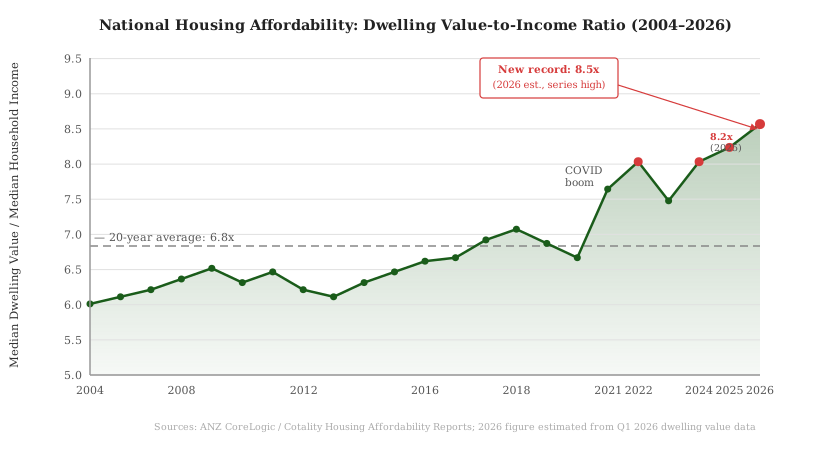
It is true that since negative gearing and capital gains tax concessions were introduced, housing affordability has declined significantly. These incentives may have contributed by increasing investor demand — but they are not the primary cause.

Significant research by Ross Kendall and Peter Tulip — both senior economists at the RBA at the time of publication (RBA Research Discussion Paper, 2018) — quantified how planning and zoning restrictions raise prices above the marginal cost of supply. As of 2016, zoning raised detached house prices 73% above marginal cost in Sydney, 69% in Melbourne, 42% in Brisbane, and 54% in Perth. The principal drivers of affordability deterioration have been low interest rates over an extended period, high population growth, chronic under-supply, and restricted access to development-ready land. Tax incentives for private investors has not been main driving force for the affordability crises and price growth.

Punishing the private investor does not address any of these structural drivers. It simply removes the capital that historically kept the private rental market functioning.
The build to rent imbalance no one is talking about

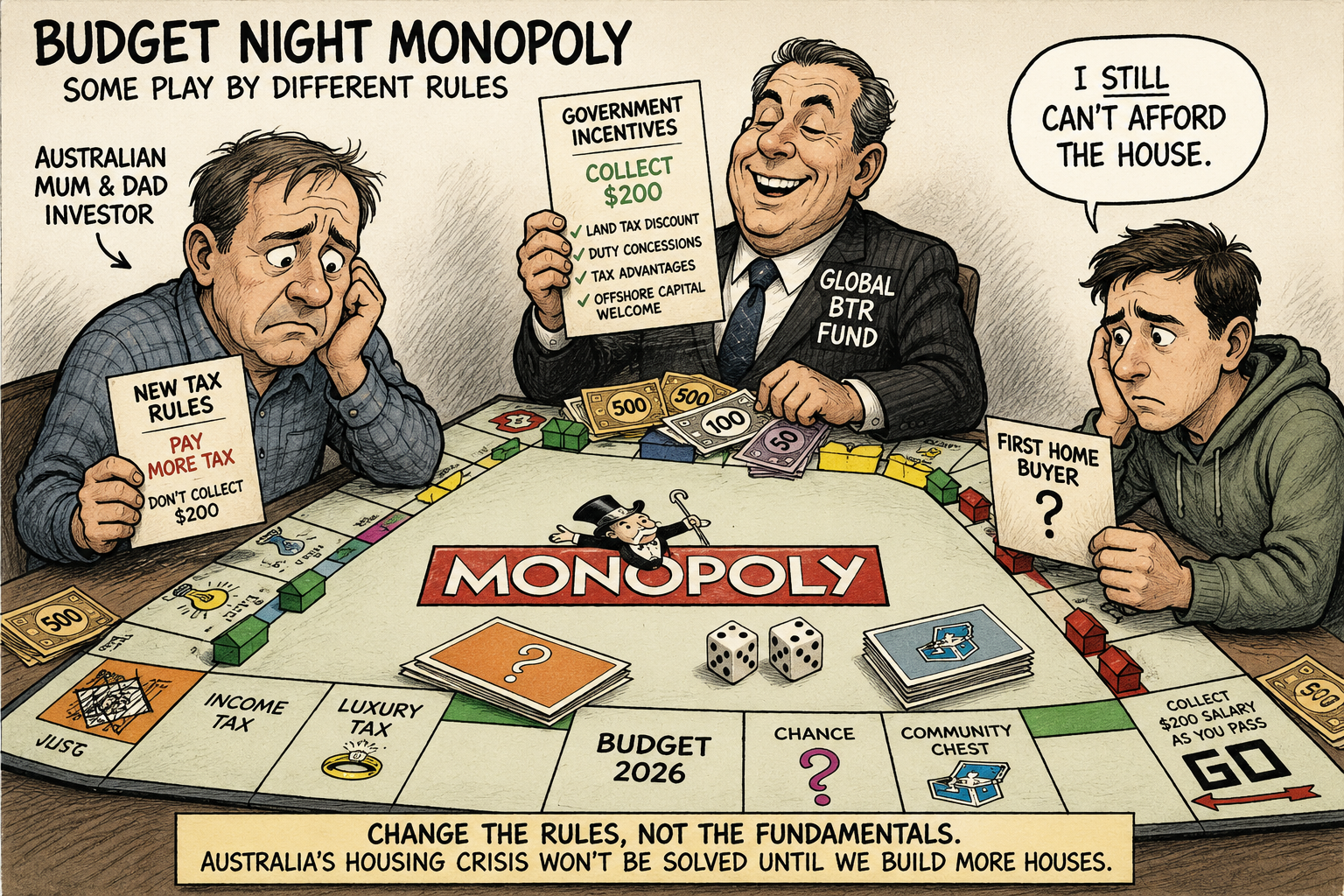
At the same time that the government is restricting tax benefits for the Australian mum-and-dad investor, it has created a materially superior tax environment for foreign institutional capital through Build-to-Rent (BTR).

Under the BTR framework, foreign institutional investors operating through a Managed Investment Trust (MIT) pay a withholding tax rate of just 15% on fund payments — down from 30%. They also benefit from an accelerated capital works deduction of 4% per year (compared to 2.5% previously), writing off construction costs over 25 years instead of 40. And crucially, BTR developments are explicitly exempt from the negative gearing restrictions announced in this Budget.

Table 1: Federal Tax Treatment — Australian Investor vs. Foreign BTR Institutional Investor
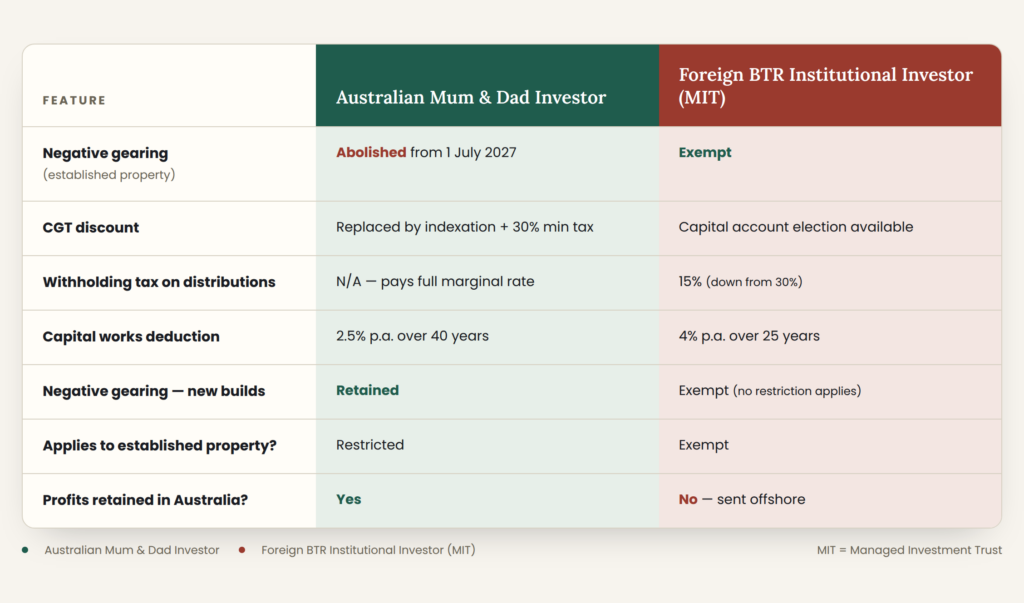
Source: ATO Build-to-Rent Development Tax Incentives; Baker McKenzie Budget Analysis May 2026; William Buck Federal Budget Analysis 2026.


“Every major state has handed foreign institutions a tax advantage unavailable to any Australian private investor.”

The asymmetry does not end at the federal level. At the state level, every major jurisdiction — NSW, Victoria, Queensland, Western Australia, and South Australia — has introduced additional BTR concessions that further widen the gap. These include 50% reductions in land tax, full exemptions from foreign investor surcharges, and exemptions from additional foreign acquirer duty. The Australian mum-and-dad investor receives none of these benefits.

Table 2: State & Territory Concessions — BTR (Foreign Institutional) vs. Australian Private Investor
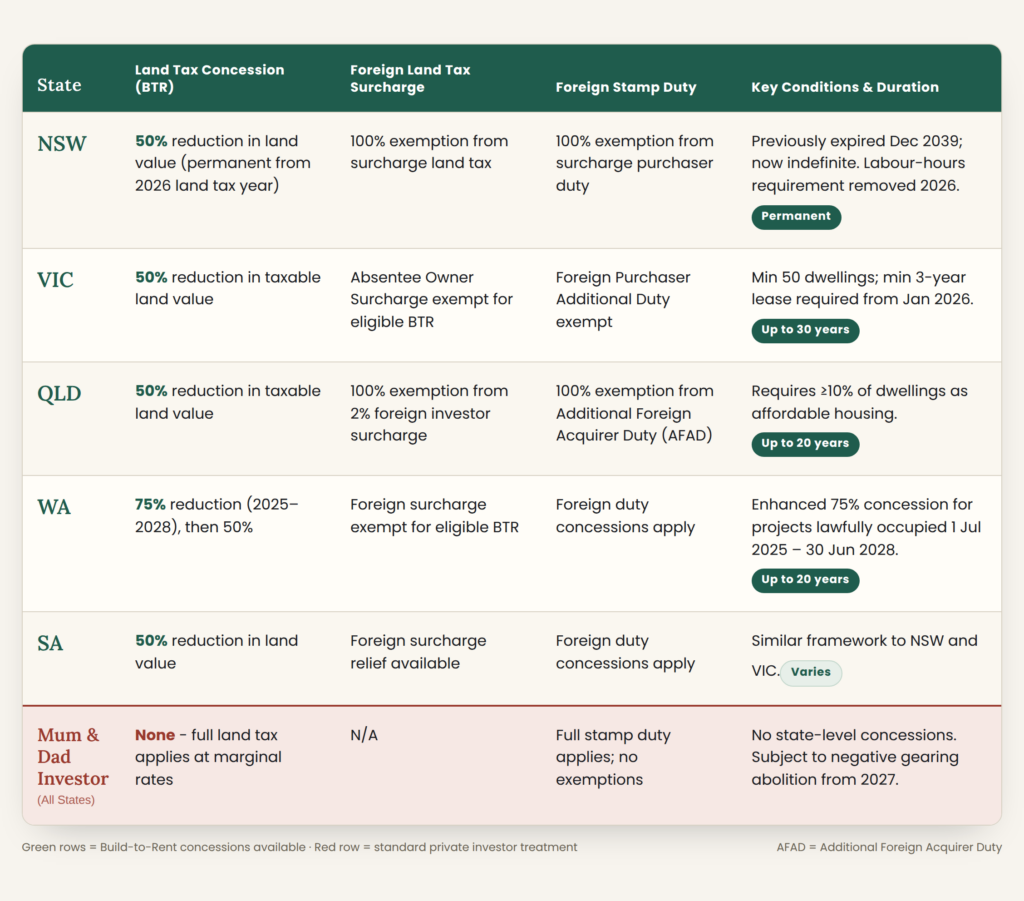
Source: Revenue NSW; State Revenue Office Victoria; Queensland Revenue Office; KPMG BTR State Concessions Analysis; Johnson Winter Slattery BTR Update 2026; Clayton Utz State Budget Review 2025.


The cumulative picture is striking. A foreign institutional investor acquiring a BTR asset in NSW today benefits from: a 50% permanent reduction in land tax, a full exemption from the 5% foreign land tax surcharge, a full exemption from the 9% foreign surcharge purchaser duty, a 15% MIT withholding rate (versus the standard 30%), and accelerated depreciation at 4% per annum. They are also exempt from the negative gearing abolition. The Australian private investor receives none of these benefits, and from 2027, loses the ones they had.

This is not solving the housing crisis. It is transferring ownership of it — from Australians to offshore institutional capital, with profits repatriated abroad and an accumulating tax advantage that no private Australian investor can match.

The unintended consequences are already in the credit cycle

What the modellers and Treasury economists consistently underestimate is the transmission through the credit cycle.

We are already seeing it at Major Banks are removing negative gearing from serviceability calculations for new investment property loans. In a falling market, lenders become less willing to support clients who are underwater, and less willing to extend credit to new investors whose cash flow projections no longer stack up without the tax benefit. The velocity of property transactions is already slowing — a direct consequence of policy uncertainty and reduced investor appetite.

This matters for state governments in ways that are rarely discussed. Transfer duty — stamp duty — is the single largest own-source revenue item for most state governments. NSW generates over $12 billion per year from transfer duty alone. Victoria, Queensland, and Western Australia rely on it to fund public infrastructure, health, and education. If transaction volumes fall by 15–20% as investor demand retreats and market confidence weakens, the revenue impact on state budgets is not marginal — it is a structural hole.

A slowdown in property transactions does not only impact stamp duty. It flows through to GST on new builds, payroll tax on construction workers, and land tax assessments. The multiplier effect of property on state government revenue has been chronically underappreciated, and the federal government has made a decision with enormous state fiscal consequences without, it appears, adequately consulting those who bear them.

The 95% loan trap

There is one more element of this Budget that genuinely concerns me, and it sits on the other side of the ledger.

The government has expanded access to first-home buyer deposit guarantee schemes, allowing eligible buyers to purchase with a 5% deposit guaranteed by the Commonwealth. The intention is benign — help young Australians into the market. The reality is that in a market already showing signs of correction, thousands of buyers are being lured into 95% loan-to-value mortgages at the top of an uncertain cycle. According to Housing Australia 300,000 applications have been sought.

If property prices in Sydney and Melbourne decline 10–15% from peak — which is already occurring in some segments — a buyer who entered on a 5% deposit has immediate negative equity. They become prisoners of their mortgage. They cannot sell without crystallising a loss they cannot afford to absorb. The taxpayer guarantees their loan. The bank is protected. The buyer is trapped.

This is not intergenerational wealth creation. It is an intergenerational debt obligation. I would never advise my own children to borrow at 95% LVR — that goes against thirty years of working with debt. The fact that the government is actively encouraging this level of leverage is, at the very least, irresponsible.

Where this leaves investors

In the near term, capital reallocation across the investment landscape appears rational and unsurprising given the policy environment. A number of investors appear to be increasing weightings toward income-generating assets while the medium-term outlook — both policy and market — becomes clearer.

On the property market itself, a disorderly correction appears unlikely given property’s structural importance to household wealth and state government revenue. But we are in a period of genuine adjustment — and the Budget has extended the duration of that adjustment.

The government had a genuine opportunity to address the housing crisis by incentivising supply, reforming planning, and reducing construction costs. Instead, it chose Robin Hood politics. The optics are appealing. The economics are not.

Every Australian will feel the consequences — in higher rents, slower wealth creation, and a future where large portions of Australia’s rental stock are owned by offshore institutions extracting returns from tenants who were, once, able to aspire to ownership of their own.

Disclaimer

Msquared Capital Pty Ltd ACN 622 507 297 AFSL 520293. This article is for general information purposes only and has been prepared without taking into account your individual objectives, financial situation, or needs. It does not constitute personal financial product advice, investment advice, or a recommendation to acquire or dispose of any financial product. Before making any investment decision, you should seek independent financial, legal, and taxation advice. This article contains forward-looking statements and opinions that reflect the author’s views as at June 2026 and may not reflect subsequent market, legislative, or policy developments. Msquared Capital has not independently verified all third-party data and does not warrant its accuracy or completeness; data was current as at the date of publication and may have changed.


A better solution to Australia’s housing crisis is unfolding 16,500km away

Changes to negative gearing and capital gains tax have already triggered a sharp pullback in investor demand for property. Msquared Capital Co-Founder and Fund Manager Paul Miron warns property prices could fall materially more than 10% if clearance rates keep trending below 50%.

In his view, the real drivers of Australia’s affordability crisis aren’t negative gearing, but unsustainable migration levels, slow planning approvals and a challenged construction sector. To solve the housing supply crisis, he points to Canada, where reducing migration intake 20% has already eased rents and housing-driven inflation.

Miron also flags a knock-on risk closer to home: grandfathering rules will discourage landlords from selling, dragging down property turnover and the stamp duty revenue states rely on to fund essential services.

Key points:

  • Budget tax changes seen as worsening housing supply and rental pressures
  • Grandfathering rules viewed as reducing property turnover and state stamp duty revenue
  • Canada’s migration cuts cited as a model for lowering rents and inflation


Watch the interview with Ausbiz

Disclaimer:

Msquared Capital Pty Ltd ACN 622 507 297 AFSL 520293. The information provided is general in nature and reflects the views of the speaker at the time of recording. Forward-looking information is inherently uncertain, and actual results may differ materially from projections. The information has been prepared without taking into account your objectives, financial situation or needs, and does not constitute personal financial product advice, investment advice or a recommendation. Before making any investment decision, you should consider whether the information is appropriate to your circumstances and seek independent financial advice.

The budget will not fix housing. It might make it worse.

The housing crisis is going to get much worse before it gets better. The RBA had little option last week but to raise interest rates. As this decision reverberates throughout the economy, Australians will become hyper-focused on inflation, interest rates, and whether we are already in recession. The economy has already been contracting, so why would the RBA inflict more pain on mortgage holders?

Because it has no choice. Eight of nine board members voted to raise rates. Inflation was gaining momentum well before the Middle East crisis erupted, and the threat is now compounding.

“Inflation is as violent as a mugger, as frightening as an armed robber, and as deadly as a hit man.” — Ronald Reagan

Looking back through economic history, unanchored inflation is not something to be taken lightly. It will steal your money while you sleep, and if left unaddressed, it will worsen and prolong economic pain far beyond the initial shock. Monetary policy alone cannot fix this. The economy needs fiscal policy to be reined in. This budget may be one of the most consequential in our economic history many economists understand we are on a knife-edge, and the decisions made in the next few weeks will echo for a decade.

Housing inflation: the engine driving the crisis

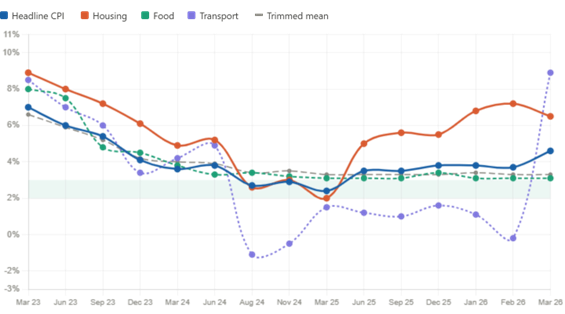
Housing inflation has averaged 6% over the past twelve months – the single largest contributor to overall CPI. The only ways to reduce pressure are to increase supply through new construction or to reduce demand through lower migration and tax reform. But neither addresses the existing shortage of approximately 400,000 dwellings. And the unintended consequence of tax incentives will remove investment properties from the rental pool, resulting in higher rents, which feed directly back into inflation.

Chart: Australia CPI inflation by component | Quarterly data Mar 2023 – Mar 2026 

The 2024 CPI trough was largely an illusion — created by government electricity and fuel rebates masking underlying inflation. The trimmed mean never fell below 3.4%, and housing never entered the RBA target band. The re-acceleration in 2025–26 reflects rebate expiry plus the Middle East energy shock, with the underlying problem — a structural housing supply deficit — unresolved throughout.

CPI Peak

7.8%

CPI Trough (Aug 24)

2.7%

CPI Now (Mar 26)

4.6%

Trimmed mean

3.3%

Source: ABS Consumer Price Index, Cat. 6401.0 / 6484.0 · RBA target band 2–3%

Collateral damage already felt in property

With 67% of Australian household wealth held in property, and the sector contributing 10.6% to national GDP, it is both the heart and engine room of the economy. Price instability here is not a sector-specific problem it is a systemic risk.

We are already seeing negative price movements in Melbourne and Sydney. Property data lags two to three months, but a leading indicator — the auction clearance rate — has sat between 50% and 60% for several weeks, signalling weakness. Reduced borrowing capacity, increased investor hesitancy, and negative sentiment are compounding. In certain market segments, we are already seeing price corrections of 10%.

Mistakenly, people believe that mining is the single most important growth sector. When it comes to employment and related businesses, it is by far the biggest contributor, as the table below shows.

Table: The property sector pays more tax than the mining sector while affecting more Australian jobs

Feature Property industry Mining industry
Direct GDP Contribution ~10.6% ~ 14.3%
Total GDP (incl. flow on) ~13-15% ~ 15-18%
Direct employment ~1.4 million ~300,000
Export share Minimal 70%
Tax contribution ~ 129.6 billion ~ 74 billion incl royalties

We are not building enough

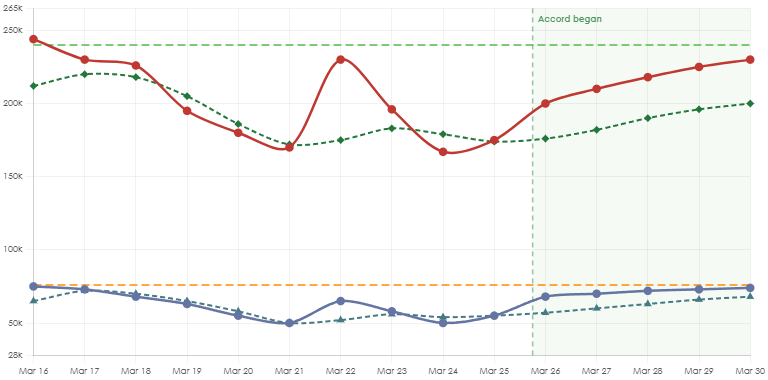
According to the National Housing Accord, Australia needs to build 240,000 dwellings each year. Despite approvals trending upward, the pipeline from approval to delivery remains long. State governments have reduced some red tape, and gains have been made — but for developers, the conditions required to commence a project profitably — market stability, accessible labour, and available capital — are deteriorating simultaneously.

We are not close to bridging the supply gap of roughly 66,000 dwellings per year. That gap compounds the inflationary problem every year it persists. Critically, the chart above reveals a story that approvals data alone conceals: the gap between approvals and completions has widened sharply. Approvals are recovering toward 200,000 — but completions are running at 174,000 and declining. An approval that never becomes a completed home does nothing to address supply or inflation.

Chart: 12 month dwelling approvals and completions – National vs NSW

National Approvals
recovering but volatile

~200,000

National Completions
27% below target

~174,000

NSW Approvals
improving off low base

~68,000

NSW Completions
28% below target

~55,000

Source: ABS Building Approvals (8731.0) & Building Activity (8752.0)· NHSAC State of the Housing System 2026. Accord began July 2024. Shaded area = Accord period. Post-2026 projections based on NHSAC 2026 base case. Completions derived from ABS Building Activity quarterly rolling 12-month totals.

The triple blow: construction inflation, tax intervention and the wealth effect

Allowing the housing crisis to worsen over decades has dealt a triple blow to the economy, and the problem is self-perpetuating as long as supply does not exceed demand.

The building paradox is stark: demand for property has never been higher, yet fewer and fewer projects will commence. Construction inflation is surging. Supply chain disruptions from the Middle East conflict are worsening. Builders are increasingly unwilling to carry contract risk. The cost of capital is rising. And with property values under pressure, project feasibility is deteriorating from both sides of the ledger.

Construction cost inflation is trending at 4.2%, double the pre-COVID average of 2%, and the Middle East energy shock threatens to push that figure toward 10%, conservatively eliminating a further 10,000–33,000 homes from the pipeline by 2029, according to the NHSAC State of the Housing System 2026.

This is not merely a pricing problem. Speaking to builders directly, the concern is not only cost increases — it is supply chain breakdown, with significant delays in key materials already threatening project completions. Builders are now hesitating to commit to major projects when input costs are this uncertain. Force majeure clauses are appearing in construction contracts, shifting risk away from builders and onto developers and lenders. This is a fundamental reshaping of the lending landscape — and it is happening in real time.

EXPERT VIEW — Peter Paradise, Construction Lawyer, Paradise Charnock Hing

“We are seeing several force majeure claims under existing contracts, and new contracts are incorporating what we call an ‘Exceptional Event Clause’ covering cost increases caused by the fuel crisis and geopolitical instability.

Dispute work in the construction sector has increased. Developers are dealing with more post-completion defects caused by mid-cycle cost-cutting. The Building Commissioner has been more active, and multi-residential has seen significant delays and buildings not built to code.”

The budget will make each of these problems worse

The government faces a choice it has been avoiding for two decades: address the structural supply shortage with genuine reform, or continue tinkering with demand-side tax measures that will make the problem worse. Abolishing negative gearing and reducing the CGT discount will remove private capital from the rental market, shrink supply, push rents higher, and feed the very inflation the RBA is being asked to kill with rate rises.

I also appreciate the flip side of the argument that baby boomers have all generated vast wealth from property, perhaps fuelled by a property-centric tax system, making property unaffordable to the younger generation. I do not see Robin Hood policies can reverse decades of structural change.

We are in the middle of a self-reinforcing crisis. The RBA raises rates to fight inflation. Higher rates reduce project feasibility. Fewer projects commence. Supply falls further. Rents rise. Housing inflation stays elevated. The RBA raises rates again.

The only exit from this loop is supply. Not tax redistribution. Not rate hikes. Supply.

And the conditions for delivering it — stable costs, available labour, accessible finance, and investor confidence — are all moving in the wrong direction at the same time. The budget, as currently anticipated, will make each of them worse.

Australia has been here before. In 1985, negative gearing was abolished. Rents spiked, supply contracted, and the policy was reversed within two years. We appear determined to learn nothing from that lesson.

The RBA cannot build houses. Monetary policy cannot reduce construction costs or speed up planning approvals. What it can do and is doing is raise the cost of capital until something breaks. What breaks first is usually the most leveraged, the most exposed, and the least able to adapt. In the current environment, that is the development pipeline.

When the development pipeline contracts further, the housing shortage deepens, rents rise, inflation persists, and the rate cycle continues. The path out of this requires political courage the current budget does not appear to contain: a genuine commitment to supply, to density, to reducing the cost and time of construction, and to keeping private capital in the rental market rather than driving it out.

Until that commitment is made, the housing crisis will continue to worsen — and with it, the broader economic pain it inflicts on every Australian who does not already own a home.

Disclaimer

Msquared Capital Pty Ltd ACN 622 507 297 AFSL 520293. Information contained in this article is general in nature and has been prepared without taking into account your objectives, financial situation or needs. It does not constitute personal financial product advice, investment advice or a recommendation. Before making any investment decision, you should consider whether the information is appropriate to your circumstances and seek independent financial advice. Property and private credit investments carry risks, including market downturns and borrower defaults, and neither past performance nor security over property guarantees future returns or capital protection.

Broker Daily podcast: Short-term capital, long-term outcomes

Bank credit appetite is tightening month to month as rising energy costs, inflation and interest rates create a challenging environment for SMEs. Creditworthy businesses are being told no, or worse, are left waiting for an answer while the clock runs down on a time-critical opportunity.

For brokers who know how to navigate commercial finance, 2026 is proving to be one of the most significant growth opportunities seen in years.

Broker Daily interviews Michael Volkiene, General Manager Loan Origination & Credit at Msquared Capital, about how the best commercial brokers are helping borrowers weather uncertainty.

Listen on Spotify or Apple Podcasts


Discussion points:

  • A lender built by brokers, for brokers: actionable insights into how to add real value for commercial clients
  • Why shifting bank appetites are driving a surge in time-critical bridging demand, and how non-banks fill the gap while a major bank processes in the background
  • Why the best commercial brokers treat non-bank lending as a retention strategy, not a last resort
  • What lenders need from a loan submission: character, collateral and a credible exit, and how to tell a borrower’s story
  • The deal-killers brokers should identify early, including valuation gaps and incomplete disclosure, and why transparency upfront leads to faster decisions
  • What a ‘finance fit’ conversation looks like in practice, and how to plan a borrower’s pathway back to traditional lending


Disclaimer:

General information only and does not constitute financial, investment, or legal advice. Msquared Capital’s lending activities are limited to writing loans for business and/or investment purposes only. The consumer protections in the National Credit Code do not apply.

From boom to brake: Property under pressure

How are geopolitics and energy shocks shifting risk in Australia’s property and private credit markets? Paul Miron argues the latest pressures are already biting – from construction costs that could jump 20% to clearance rates in Sydney slipping toward 50%. Paul outlines why he believes some property prices have already fallen more than 10%, why lenders need to interrogate valuations more aggressively, and why secured private credit over established property remains his preferred position in volatile conditions. He also weighs in on potential tax changes – negative gearing, CGT and GST – warning that poorly timed reforms could tighten supply further and push rents higher, echoing the policy reversal of 1985.

Key points:

  • Energy shock and supply chain issues seen driving construction costs higher
  • Clearance rates and sentiment viewed as signalling property price falls already under way
  • Secured private credit over established property preferred to construction and corporate debt
  • Proposed changes to negative gearing and property tax seen as risking reduced supply and higher rents

Disclaimer:

Msquared Capital Pty Ltd ACN 622 507 297 AFSL 520293. The information provided is general in nature and reflects the views of the speaker at the time of recording. Forward-looking information is inherently uncertain, and actual results may differ materially from projections. The information has been prepared without taking into account your objectives, financial situation or needs, and does not constitute personal financial product advice, investment advice or a recommendation. Before making any investment decision, you should consider whether the information is appropriate to your circumstances and seek independent financial advice.

Our prosperity now depends on decisions politicians hate making

Msquared Capital’s Paul Miron says Australia’s economic prosperity has been built on good luck and not good policy. In an exclusive interview with Livewire’s James Marlay, Paul explores the supply and demand dynamics plaguing property markets and the broader economy. They also talk about the run of redemptions hitting high profile global private credit funds.

Written by James Marlay for Livewire Markets

Front pages today are dominated by headlines about the war in Iran. Hopefully, there’s a resolution soon. The risk is that any escalation adds to the already entrenched challenges facing Australian households and the domestic economy.

Rising inflation and cost-of-living pressures were already biting. Layer in structural issues like housing affordability, and the picture becomes more complicated. Higher input costs are likely to flow through the economy, adding further pressure where it’s already being felt.

In a recent Livewire article, Msquared Capital’s Paul Miron put the spotlight on the structural challenges confronting current and future governments.

Put simply, Miron argues Australia’s economic track record owes more to luck than good policy. Years of strong growth, particularly in property prices, have masked deeper structural weaknesses.

Australia is currently the only G12 economy to have resumed tightening monetary policy amid persistent inflation, a signal that the underlying pressures are deeper than many care to admit – Paul Miron

To an extent, this is familiar territory. Housing affordability is well documented. So too are weak productivity growth and rising levels of debt-funded government spending.

Where it gets more contentious is how to fix it. Miron’s view is that supply and demand need time to rebalance the economy. That means difficult decisions, particularly around migration settings and government spending.

Long-term structural change will come from very brave politicians – Paul Miron

What won’t work, in his view, is trying to stimulate demand in an already constrained housing market through subsidies, or discouraging investment via policies targeting property investors.

Instead, Miron outlines a series of measures aimed at restoring balance between supply and demand, which he believes is the key to easing pressure on property prices.

Given the vibrant discussion that took place in the comments on Paul’s article I reached out to him to discuss his position further. I also took the opportunity to ask him about the implications of the run on redemptions hitting a number of high profile global private credit funds for local investors.

Topics discussed

  • 0:00 – Australia’s economic Ponzi Scheme
  • 2:35 – Housing affordability – stuck between a rock and a hard place
  • 8:55 – Policy solutions require brave politicians
  • 10:57 – Why isn’t new housing affordable?
  • 13:59 – Implications of the recent redemptions in private credit funds
  • 18:46 – Australian private credit is has a point of difference
  • 21:32 – ASIC review a net positive for Australian private credit


Disclaimer

Msquared Capital Pty Ltd ACN 622 507 297 AFSL 520293. Information contained in this article is general in nature and has been prepared without taking into account your objectives, financial situation or needs. It does not constitute personal financial product advice, investment advice or a recommendation. Before making any investment decision, you should consider whether the information is appropriate to your circumstances and seek independent financial advice. Property and private credit investments carry risks, including market downturns and borrower defaults, and neither past performance nor security over property guarantees future returns or capital protection.

M2-Logo
Investor Portal

You are about to be redirected to our registry service provider. Do you wish to proceed?

Contact

(02) 9157 8608
[email protected]
Level 12, 88 Pitt Street
Sydney NSW 2000

Please note the following information has been prepared for the use of Wholesale and Professional investors only*. By clicking Agree, you are confirming you are an Australian Wholesale Investor as defined by section 761G of the Corporation Act 2001.

Please note the following information has been prepared for the use of Wholesale and Professional investors only*. By clicking Agree, you are confirming you are an Australian Wholesale Investor as defined by section 761G of the Corporation Act 2001.

We use cookies to improve your experience.