
Part 1: The economy — it’s dependency,
The most important slide of the night wasn’t about interest rates. It was about age.
Australia’s dependency ratio, the number of young and old people relative to those of working age, fell from the early 1970s until 2010. For forty years, the workforce grew faster than the population it supported. That meant excess supply, falling inflation and falling interest rates. It was the tailwind behind almost every asset price in our lifetimes.2
That tailwind has turned. Dependency has been rising since 2010, and this year the first baby boomers turn 80. Total population is a proxy for demand; the working-age population is a proxy for supply. As dependency rises, demand grows faster than the capacity to meet it. It shows up as labour shortages. Job vacancies are still around 40% above 2019 levels.2
Immigration does not solve this at the level of the whole economy. Migrants fill vacancies, but they also bring demand: they need homes, services and infrastructure. That is why population growth of 1.4% feels so different in a housing shortage.
The second force is government. Government consumption spending across all levels now takes around 23% of GDP, up from about 19% a decade ago. And governments plan to grow that spending by around 3% in FY27, while the economy’s speed limit is about 2%. Warren’s arithmetic is simple: to get inflation down, the RBA needs 18–24 months of growth below 2%, and if government takes its 3%, the private sector can barely grow at all. The RBA is pressing the brake while Canberra presses the accelerator.2,3

The third force is AI. Research cited by Warren estimates that a quarter of Australia’s workforce is in roles at high risk of displacement, and more than half will be significantly affected. In the long run, AI may be the productivity answer Australia desperately needs. In the short run, data centres compete with housing for land, power, tradespeople and capital.4
Put the three together and you get Warren’s two uncomfortable realities. Labour is scarcer, so it costs more. Capital is in demand from ageing societies, deficit-funded governments and a global AI investment boom, so it costs more too. Australia’s 10-year bond yield has hit a 15-year high of around 5.4%, and the US 30-year yield reached a 20-year high in August.2
The RBA today lifted the cash rate for the fourth time this year, to 4.60% p.a. Warren’s central case has it above 5% by early 2027, with further hikes in November and February. His reason: after inflation, the real cash rate is barely above zero. For an economy running at its speed limit, that is not restrictive enough.5,2
The RBA is also telling us how much pain it is prepared to accept. Unemployment rose to 4.6% in August, up from 4.5% in July. A week ago, Governor Michele Bullock said that unemployment “between 4.5 and 5 (per cent) will probably take enough heat out of the labour market” to ease inflation. In other words, the RBA expects, and is prepared to accept, a softer jobs market. That matters for property: interest rates create pressure, but unemployment creates forced sellers.6,7
Headline GDP will keep growing, helped by population. But when the population grows at 1.% and the economy at 1.5% (currently trending 2.1%) being the base RBA forecast, GDP per person is barely moving. That is what “going through the motions” looks like.2
Part 2: Property — it can fall further without becoming cheap
Property is where these forces meet.
As a private credit provider secured by property, we see valuations and sales every week, and in Sydney and Melbourne this is one of the sharpest corrections at the top end of the market in recent memory. On the deals crossing our desk, blue-chip suburbs are down 15–20% from their peak, traditional mortgage-belt suburbs 10–15%, and the lower end of the market around 5%. The rest of the country is following suit. 8
Encouragingly, bargain hunters are starting to return, a sign that prices may be closer to the bottom than the top. With interest rates on the rise, it may dampen any hastened recovery in the near future. But the bottom for prices and the bottom for credit are not the same thing, and that is where this story goes next.
The official index shows national values only around 3.6% below their March peak. That understates it: index data lags, and averages away what is happening at the edges of the market. 9

What is unusual is turnover: sales volumes are down about 40% from November 2025 peak. Listings are up 18% on a year ago, auction clearance rates have been below 50% since June, and vendor discounting is the highest since early 2023. A market that isn’t transacting is a market that can’t price itself.2,9
Here’s what many commentators miss: property can fall further without becoming cheap.
Affordability isn’t just the price. It is the price plus the cost of the money used to buy it. If rates rise faster than prices fall, borrowing capacity shrinks and affordability gets worse, not better. At the same time, construction costs keep rising. House construction costs are up about 51% since before COVID. That puts a floor under the value of new homes, because nobody builds what costs more to deliver than it sells for.10
That is the housing paradox. We need 1.2 million new homes, a target now not expected to be met until December 2030. Yet about 3,470 construction companies failed in 2025–26, one in four of all company insolvencies nationally. Every builder that fails is supply we don’t get, and that is a disaster for housing, for inflation and for the economy.10
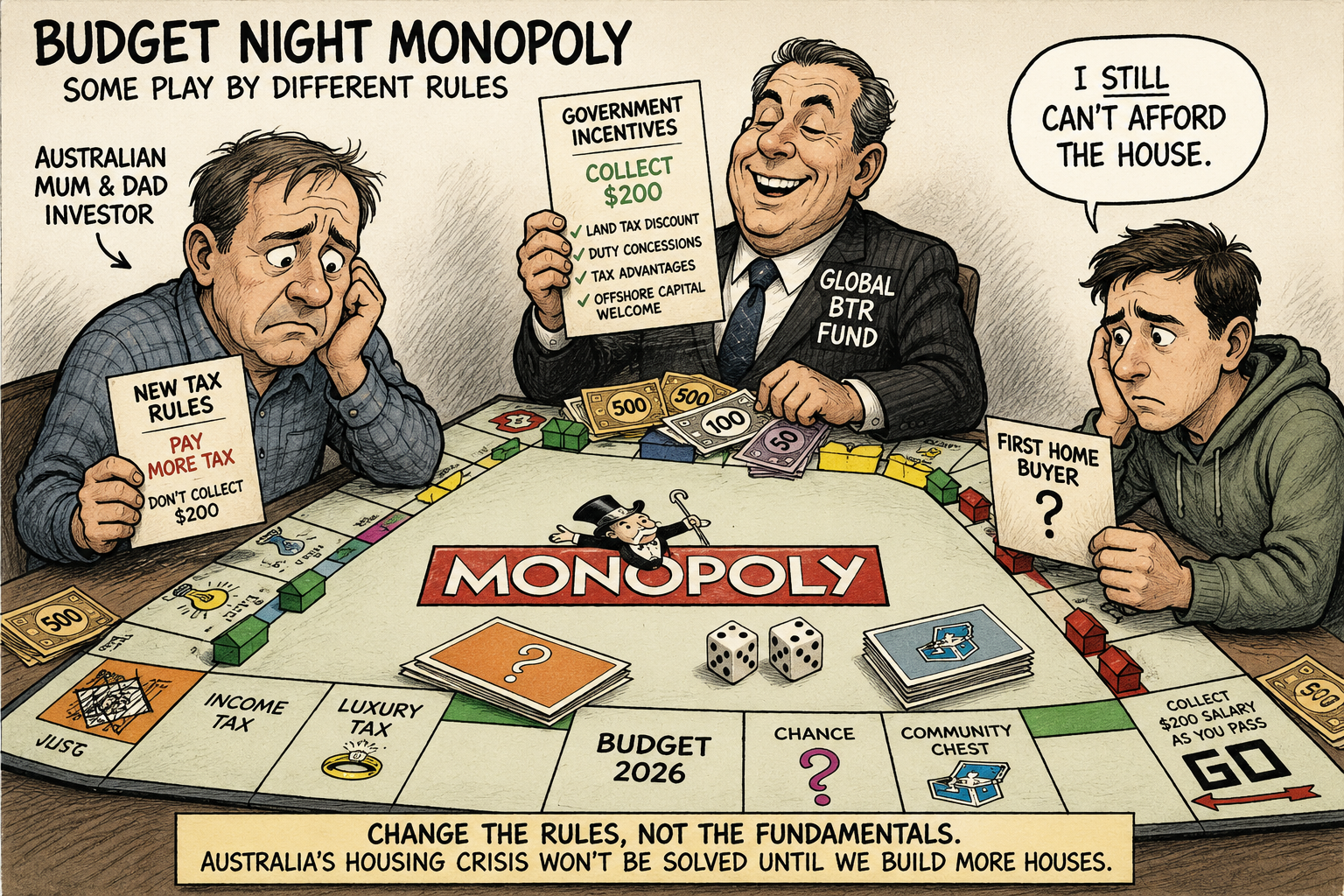
The biggest problem in property may not be falling prices. It may be projects that simply no longer stack up. And every project that doesn’t get built keeps housing unaffordable for longer.
Part 3: Private credit — a soft crunch, not a hard freeze
Bathla Group went into administration in late August owing an estimated $3.4 to $3.6 billion to around 40 lenders. About 2,000 homes were mid-construction and a pipeline of around 14,000 more is now uncertain. 1
Bathla is the tip of the iceberg. Just not the iceberg you think.

So, is Bathla the tip of the iceberg?
Large-scale, highly leveraged developers, at most.
Large residential developers need a continual flow of sales, settlements and refinancing. Their model assumes the next deal funds the last one. When sales volumes fall 40%, costs rise by double digits and funding costs double, that model breaks, whoever the lender is. Bathla was simply the largest and most visible example. We expect more developers and builders to follow, particularly those whose exit plans assume an ordinary property market.
As the music stops, developers with deeper balance sheets and lower leverage will get through, as in other cycles. Higher-leveraged developers are beginning to get caught out in what is one of the most challenging times for developers in the past decades.
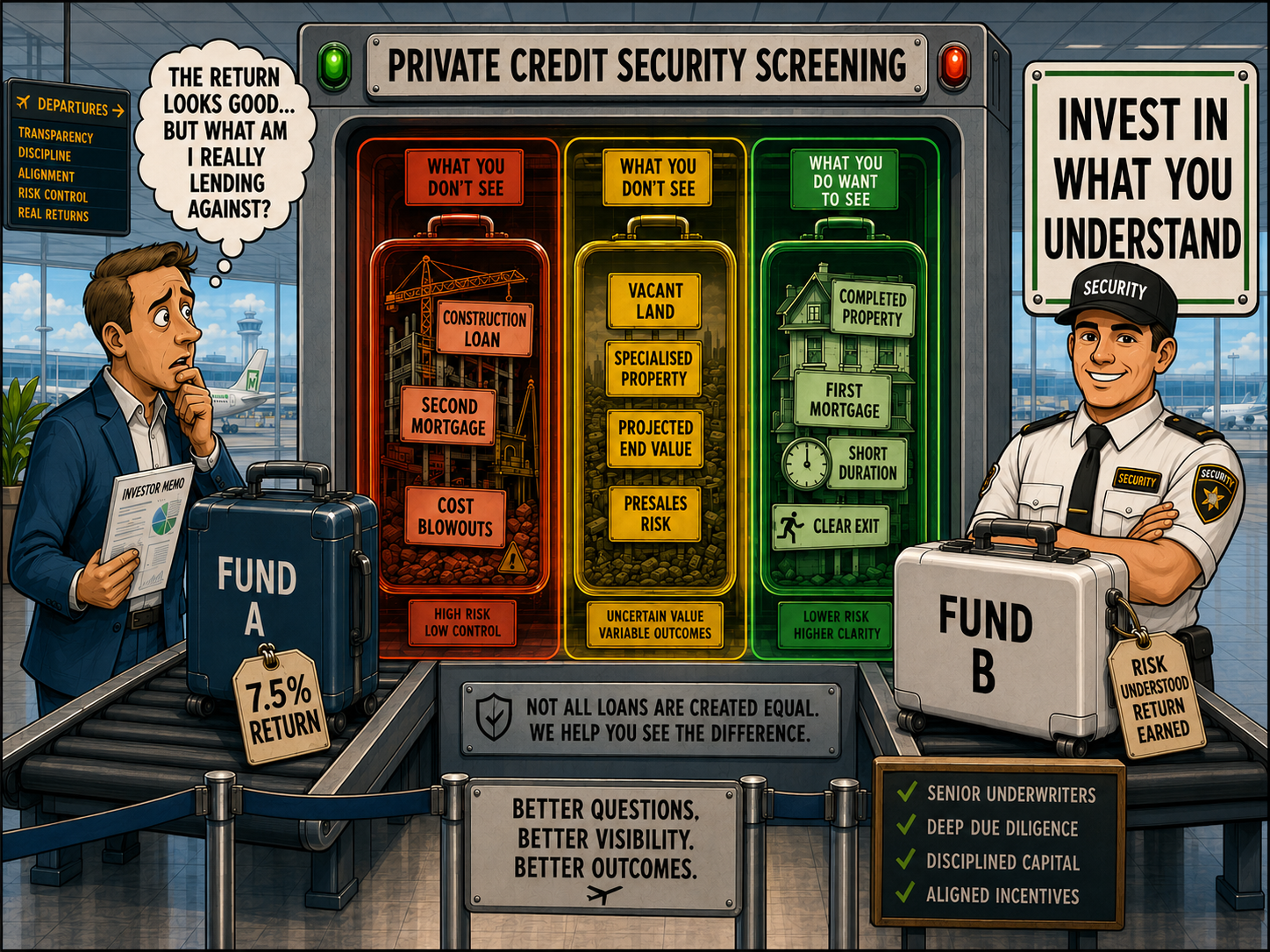
Recovering money in a mid-completed development site is not for the faint-hearted. It’s much more complex than recovering a completed property which is readily saleable.
This is why not all Private Credit is the same.
Oncoming Credit Crunch
That is why we describe what is coming as a soft credit crunch. It is not a GFC-style freeze where money disappears overnight. Money is still available, but it is more expensive, slower and far more selective. Lenders are pulling back at the same time, redemption pressure is making some funds cautious, and borrowers who relied on easy refinancing are finding the door narrower.

The distinction matters because property corrections and credit crunches end differently. A property correction ends when lower prices bring buyers back. A credit crunch ends when lenders regain confidence, and that usually takes longer. Over the next twelve months, we would pay almost as much attention to debt markets as to house prices.
Defaults will rise; that is the natural consequence of this many rate rises. But default and loss are not the same thing. A senior first mortgage at a conservative loan-to-value ratio can go into default and is more likely to recover its principal in full, as a lower loan-to-value ratio gives a lender more buffer to absorb a fall in value, but recovery is never guaranteed. Loss severity depends on how the loan was structured before the stress: the LVR, the borrower’s equity, the quality of the valuation, how long enforcement takes, enforcement costs and whether there was a genuine exit.

Poorly structured credit is the risk.