
Brokers to claim higher share of commercial lending market amid industry diversification

Brokers are handling increasingly complex scenarios across both traditional and alternative lending avenues.

Written by William Farrington – Mortgage Professional Australia

Commercial broking is, in many ways, still in its infancy.

While broker share in the residential mortgages space has seen breakneck growth – having climbed from – to nearly 80% today, brokers’ commercial market share still sits at roughly 35% to 40%, depending on who you ask.

But as the broking industry matures, many experts expect this number to shoot up in the coming years.

Michael Volkiene, general manager, loan origination and credit, of private credit group Msquared Capital, expects brokers to claim 55%-60% of the commercial lending space over the next three years.

He sees this as a result of brokers diversifying and responding to the increasingly sophisticated needs and expectations of their clients.

Private credit, he argues, is on a similar trajectory.

“In the US, close to 50% is written in private. In Europe it’s around 40%. In Australia, you probably sit between 9% and 12% at the moment,” notes Volkiene. He sees the “natural” level here moving to around 22%-25% over the same period.

Volkiene believes abundant dry powder, banks retreating from complex scenarios, and the rise of specialist non‑bank players are all helping private credit gain ground.

“Brokers are seeing some challenges with the traditional lenders,” he says, pointing to bottlenecks around SLAs, shifting appetite and confidence.

Msquared operates predominantly in the three‑ to 36‑month space, funding non‑regulated commercial deals such as bridging, residual stock and cash‑out facilities.

But while the likes of Msquared tout the benefits of the unregulated commercial lending space, sentiment is clearly bullish among the traditional players too.

Speaking on NAB’s latest commercial broker economic update, executive of commercial broker Chris Thomas highlighted “significant levels of system growth for business lending, much higher than in previous years”, noting that businesses are clearly prepared to borrow despite higher interest rates.

During the update, NAB chief economist Sally Auld said internal data shows much of the uplift is concentrated in property and agriculture, with a particularly strong appetite for the purchase of commercial buildings rather than just land or residential stock.

That pattern, she argued, signals businesses are making longer‑term bets on income‑producing assets and regional growth rather than simply chasing short‑term gains.

Auld also pointed to NAB’s business survey, which shows most firms that want credit still report it is “pretty easy” to obtain, suggesting banks remain keen to lend and current rate levels are not yet biting hard enough to choke off investment demand (although this was said prior to the March RBA rate hike).

NAB gained market share in both small-to-medium enterprise and total business lending in 2025, per its latest set of results.

Big Four competitor Westpac has also enjoyed growth in business lending. Following a concerted effort by management to target the commercial space, interim results published last September showed a 14% year-on-year growth in the segment.

Brokers urged to diversify

Brokers can no longer afford to be “resi‑only” players, says Volkiene, who sees diversification into commercial as both inevitable and accelerating.

He says brokers want to provide “cradle to grave” solutions for clients, supporting them as they move between residential, business and investment needs.

“Commercial lending is relationship driven and technically complex,” says Volkiene.

“Experience matters – from understanding diverse income streams and non‑standard documentation, to taking a commercial approach to valuations.”

Volkiene reckons commercial expertise gives brokers a way to deepen their client relationships and grow their businesses. Others in the broking industry thoroughly agree.

In ongoing roadshows across Australia and New Zealand, Simon Bednar, chief executive of mortgage aggregator Finsure, has been stressing the importance of diversification, especially in response to the Middle East crisis that is causing havoc on fuel prices and consumer confidence.

“We are all facing challenging times with interest rate increases and market fluctuations outside of our control. It’s important for brokers to be prepared to diversify their service offering and revenue streams in response to these events,” Bednar told brokers.

He continued: “This will enable brokers to offset the negative impact of rate rises and better protect their businesses from unpredictable outside forces. Our industry is increasingly moving towards a more professional approach which helps develop more loyal clients during difficult times.”

Finsure saw a 43% surge in commercial and asset finance lending in its latest financial year.

“We are seeing more and more brokers moving into diversified lending – particularly commercial – as they look to expand their revenue in this competitive environment,” said Bednar.

Mortgage aggregators crack into commercial

Finsure is not the only mortgage broking group to see similar trends.

Connective recently powered up its commercial lending offering by adding ORDE Financial, Pallas Capital and Msquared Capital to its lender panel.

Brent Starrenburg, head of commercial and asset finance at Connective, is seeing brokers navigate increasingly complex commercial lending scenarios.

Additions like Msquared to Connective’s lender panel to flesh out the options available to brokers handling these complex scenarios.

“Msquared Capital brings strong commercial experience and a practical credit approach, particularly for more complex property transactions,” says Starrenburg.

“That gives our brokers confidence they can deliver when traditional options fall short.”

LMG, Australia’s largest mortgage aggregator, has also made an aggressive push into commercial broking.

“The average person is going to have financial needs beyond just a mortgage… What we’re seeing is good brokers want to say to their customer, ‘I’m your destination for all your financial needs, whether that’s a car loan or if you want to buy a factory,” LMG group executive of commercial finance Stephen Scahill told MPA at last year’s LMG Growth Summit.

“It’s about convenience for customers, but for brokers it’s also about securing your own network,” said Scahill.

Disclaimer:

General information only and does not constitute financial, investment, or legal advice. Msquared Capital’s lending activities are limited to writing loans for business and/or investment purposes only. The consumer protections in the National Credit Code do not apply.

The flight to quality in Australian private credit

Despite weak consumer confidence and geopolitical uncertainty, Australian borrowers with strong balance sheets are re‑gearing to capture business opportunities. Msquared Capital’s General Manager Loan Origination & Credit Michael Volkiene tells ausbiz that rising interest rates have not subdued the impact investor demand for yield has on lenders, where the contest for quality borrowers is intensifying. He expects continued strong growth in activity from entrepreneurial Australian SMEs for the remainder of the year.

Key points:

  • Rising competition and a flight to quality in Australian private credit
  • Rate hikes seen as expanding the opportunity set for non‑bank and private lenders
  • Market viewed as maturing towards higher private credit penetration over coming years
  • Private credit framed as a portfolio component where risks and liquidity are well understood

Disclaimer:

Msquared Capital Pty Ltd ACN 622 507 297 AFSL 520293. The information provided is general in nature and reflects the views of the speaker at the time of recording. Forward-looking information is inherently uncertain, and actual results may differ materially from projections. The information has been prepared without taking into account your objectives, financial situation or needs, and does not constitute personal financial product advice, investment advice or a recommendation. Before making any investment decision, you should consider whether the information is appropriate to your circumstances and seek independent financial advice.

Non-banks see surge in commercial lending demand as banks retreat

Findings from Msquared Capital indicate that demand for specialist non-bank lenders is rising as major banks step back from complex commercial lending scenarios. The lender says it is seeing a sharp increase in commercial borrower enquiries heading into 2026 as businesses refinance to manage higher interest rates, address tax obligations and inject fresh working capital.

Written by Julian Barnes – Broker Daily

Msquared Capital general manager of loan origination and credit Michael Volkiene said the trend reflects a broader shift in how commercial borrowers are accessing finance.

“Some lenders are increasingly stepping away from transactions involving complex structures, mixed-use assets or non-standard income,” Volkiene said.

“Borrowers are seeking flexibility and speed, which is driving strong demand for short-term commercial lending solutions.”

New funding strategies

According to Volkiene, new pressure means that many businesses entering 2026 are refinancing not only to secure competitive rates but to restructure their balance sheets and start the year with additional liquidity.

Msquared Capital’s findings come following the    release of new research, which suggests Australian SMEs are facing mounting cash flow pressures. A recent Prospa SME Sentiment Report, conducted with YouGov, found that upcoming Payday Super reforms are expected to tighten already thin working capital buffers for many small businesses, potentially increasing demand for external funding solutions.

From 1 July 2026, employers will be required to pay superannuation at the same time as wages rather than quarterly, changing the timing of cash outflows for businesses. The report found that 41 per cent of SMEs are either unaware of the reform or do not fully understand it, while 30 per cent say they are unsure or unprepared to meet the new payment cadence.

Additionally, other surveys have shown that SMEs may be delaying investments, but remain intent on growing this year, and that business and commercial loan    demand has remained robust so far in 2026.

“We’re not seeing businesses retreat – we’re seeing them recalibrate,” Volkiene said.

“Refinancing is increasingly strategic. It’s about certainty and flexibility, particularly where timing matters.”

Complex solutions

The shift comes as mortgage brokers increasingly encounter complex commercial scenarios that may fall outside the appetite of traditional lenders.

Msquared Capital said this has contributed to stronger interest from mortgage aggregators seeking to expand their commercial lending panels with specialist lenders capable of handling more complicated transactions.

“Business loans secured by residential property assets are the easiest to execute. Very few lenders have the experience needed to navigate complex commercial structures quickly or take a practical view on commercial and industrial property assets,” Volkiene said.

“Aggregators are increasingly focused on credibility and execution, not just capital availability.”

Msquared Capital, which provides real estate-backed loans ranging from $500,000 to $50 million, has recorded 30 per cent year-on-year growth. The firm  recently joined Connective’s commercial panel.   

Broker demand for non-bank commercial lending options continues to increase.

Connective head of commercial and asset finance Brent Starrenburg said brokers are increasingly dealing with more complex commercial lending scenarios.

“We’re seeing more brokers navigate complex commercial scenarios. Msquared Capital brings strong commercial experience and a practical credit approach, particularly for more complex property transactions,” Starrenburg said.

Volkiene said the growth of the non-bank sector has also seen new entrants emerge to fill gaps left by traditional lenders, increasing the importance of experience when structuring commercial deals.

“Commercial lending is relationship-driven and technically complex. Brokers are reporting long wait times on complex scenarios across providers,” he said.

“In this environment, experience matters – from understanding diverse income streams and non-standard documentation, to taking a commercial approach to valuations.”

Similarly, non-bank lender Bizcap told Broker Daily that SMEs are not borrowing just to grow, but to manage timing gaps created by regulatory reform, labour obligations and tightening commercial terms, pressures which are exposing the limits of traditional, static credit models.

Starrenburg added that brokers are increasingly prioritising certainty of funding and transparent lending terms when selecting commercial lending partners.

Disclaimer:

General information only and does not constitute financial, investment, or legal advice. Msquared Capital’s lending activities are limited to writing loans for business and/or investment purposes only. The consumer protections in the National Credit Code do not apply.

Has Australia Reached the End of the Great Economic Ponzi Scheme?

As rising inflation and a worsening housing crisis puts political heat on the property market, Msquared Capital Co-Founder & Fund Manager Paul Miron breaks down why the Australian economy is unravelling after decades of success. He unpacks the dangerously underestimated consequence Robin Hood politics may have for all Australians.

For decades, Australia has been known as the lucky country. Yet luck is not an economic strategy.

In recent years, structural weaknesses that were once masked by growth have been exposed. Australia is currently the only G12 economy to have resumed tightening monetary policy amid persistent inflation, a signal that the underlying pressures are deeper than many care to admit.

Recent OECD data showed Australia recorded one of the largest declines in real household disposable income per capita among advanced economies. Real wages have lagged inflation for several years, meaning Australians are effectively working more to afford less. On a per-capita basis, national income has stagnated and in some periods, gone backwards.

For a generation, Australia rode an extraordinary wave:

  • A once-in-a-century mining boom driven by China
  • A banking system expanding credit into housing
  • Rapid population growth through migration
  • A property market that rarely corrected


Between 1991 and 2020, Australia avoided recession, one of the longest uninterrupted GDP expansions in modern history. This built enormous wealth on paper. Median household wealth ranks among the highest globally. But much of that wealth is tied to property values, approx 67% of our wealth, which is inflated by leverage and demographic growth.

The economic model has worked so far. But the supply side of the economy has been unable to adapt as it has in the past. Has it reached the breaking point?

The Illusion of Growth

For years, GDP growth and low unemployment were treated as proof of sound economic management. On paper, Australia still ticks those boxes.

But GDP growth driven primarily by population expansion is not the same as productivity growth. When output rises simply because more people are added, living standards do not necessarily improve.

Per capita outcomes tell a different story.

Australia has been absorbing one of the highest net migration rates in the OECD. Historically, the supply side of the economy expanded to accommodate this growth. Today, it appears constrained:

  • Infrastructure projects are competing with residential construction for labour and materials
  • Housing supply is lagging population growth
  • Rental vacancies sit near record lows
  • Construction insolvencies are elevated


We are at or near full employment, yet productivity growth has stalled. Since around 2016, labour productivity growth has averaged close to zero, in some years, negative. That means we are adding hours worked without meaningfully increasing output per hour.

In simple terms, we are running faster but not making any further progress.

Structural pressures converging, before the Middle East war

The Australian economy now faces simultaneous, converging structural challenges that have been brewing for over a decade, and both sides of politics are equally to blame. The uncertainties of war in the Middle East will conveniently provide politicians with an excuse to lay blame for higher inflation, higher interest rates, higher living costs, and energy costs when these issues become more critical and apparent in the coming months.

Record public debt, spending, and inflation are all linked

Australians will wake to a $1 trillion government debt this year. Government spending represents 26% of GDP, the highest it has ever been. Spending has grown faster than tax revenue for over 20 years. The difference has been fuelled by debt.

There has been no better economist in our history than the late Milton Friedman, whose life’s work was to understand better inflation, famous for saying, “The only way to finance government spending without taxes is by creating money, and that produces inflation.”

We need to appreciate that the RBA is independent, and its instrument to control inflation is interest rates; however, the other equation in our economy is fiscal spending.

It is exceptionally rare for an ex-RBA governor to comment that “Government handouts have contributed to higher interest rates,” call out the government, and provide such open criticism of government spending, resulting in higher interest rates, weaker wage growth, and slower economic growth.

So where Is the “Ponzi”?

The uncomfortable question is whether Australia’s economic model has relied too heavily on three reinforcing forces:

  1. Rising property values
  2. Expanding credit
  3. Population growth


When asset prices rise, households feel wealthier. They borrow more. Banks lend more. Governments collect more stamp duty and GST. Migration adds demand. GDP grows. Confidence builds.

But if productivity stalls, and debt continues to expand faster than real income, the system becomes increasingly dependent on continual growth in asset values and population inflows to sustain itself.

That dynamic begins to resemble something fragile.

Not a fraud — but a structure that requires constant expansion to remain stable.

Housing supply vs demand

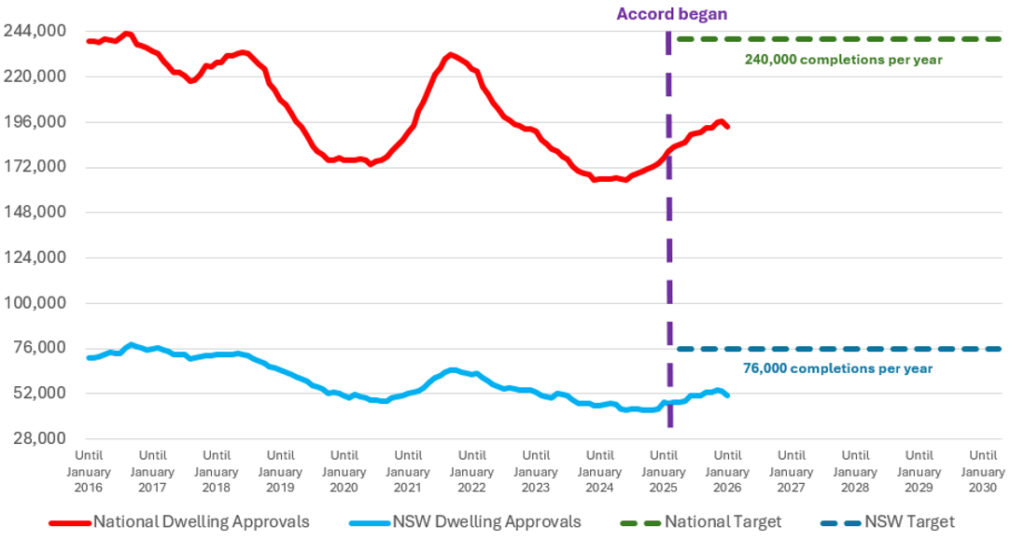
The National Housing Accord sets a target of 1.2 million homes over five years (240,000 per year).

However, ABS Building Activity data show annual dwelling completions currently below that level, at just under 184,000. With building approvals falling further, the issue will only be exacerbated over the longer term.


Source: Urban Taskforce based on ABS data released 3/3/26

Meanwhile:

  • Rental vacancy rates are near record lows (CoreLogic / SQM Research).
  • Construction insolvencies have risen sharply (ASIC insolvency statistics).


Record infrastructure spending (federal and state) has exceeded $120 billion in pipeline projects nationally (Infrastructure Australia), competing directly with residential construction for skilled labour and materials, which is contributing to housing construction inflation of well over 5% pa.

But it is a model that requires perpetual expansion to maintain stability.

The latest CPI data shows housing as one of the largest contributors to inflation. In January, housing costs rose approximately 6.8% year-on-year, driven by rents, construction costs and utilities.

The private sector is responsible for generating this, comprising an army of mum-and-dad property investors and developers, as well as institutional-sized developers. With construction costs being so high, red tape, and high land values, the numbers at present do not stack up. The result is that the growth corridor areas where supply is supposed to be delivered via decades of infrastructure and planning are not feasible, with more projects stalled until it becomes profitable, the only mechanism available being higher property prices.

CGT discounts and negative gearing

We recently had a 3-day Senate enquiry, listening to economists, on the relationship between high property prices, affordability, and the stability of our housing market.

There is no doubt that tax incentives have contributed to property values over the past two decades, drawing additional demand from property investors; however, the flip side is that without these incentives, fewer properties would have been delivered. Sometimes we need to accept that we cannot fix the problem retrospectively.

The government is seeking to raise further taxes to plug the hole in our budget. My concern is that removing incentives for private sector development will exacerbate the housing crisis further. As an unintended consequence, property prices may go down in the very short term, but then artificially inflate as the supply shortage deepens.

In this scenario, we can expect higher inflation, particularly as rental property supply dwindles and our growth relies on sustaining high levels of migration. Not to mention, it undermines people’s aspirations to work hard and build wealth, since property has long been a tangible, straightforward way to build wealth.

The optics of Robin Hood politics look great, but economically, we all end up suffering if we exacerbate the housing crisis.

Keep in mind that 71% of property investors have one property; these are not ultra-rich people, but regular, hardworking Australians who managed to save enough money to buy an investment property.

It seems reasonable to do the opposite

From an economic perspective, it seems reasonable to provide incentives to increase the supply of property and attract much-needed capital investment.

As we enter a new economic phase, Australia’s future prosperity will not come from rising property prices or population growth alone. It will be both economically and politically suicidal to drastically interfere with the property market. Therefore, I believe property will remain stable, with private credit given a strong foundation to remain a solid and reliable asset class, as long as the manager maintains a high level of discipline.

Our prosperity will come from producing more value per person, not simply adding more people or more debt to the system.

The question is not whether the lucky country can remain prosperous.

The real question is whether Australia can transition from a model built on expansion to one built on productivity, innovation, and sustainable growth.

Disclaimer:

Msquared Capital Pty Ltd ACN 622 507 297 AFSL 520293. Information contained in this article is general in nature and has been prepared without taking into account your objectives, financial situation or needs. It does not constitute personal financial product advice, investment advice or a recommendation. Before making any investment decision, you should consider whether the information is appropriate to your circumstances and seek independent financial advice. Property and private credit investments carry risks, including market downturns and borrower defaults, and neither past performance nor security over property guarantees future returns or capital protection.

Top-tier commercial lender Msquared Capital joins Connective commercial panel

Following unprecedented growth in commercial lending demand, Connective has added Msquared Capital to its panel to bolster options for brokers servicing complex commercial lending scenarios.

Specialising in short-term loans, the private credit firm has been added to provide up to 80% LVR lending against residential, commercial and industrial securities.

Msquared Capital was founded in 2017 by former brokers and bankers who specialise in commercial lending. The firm now helps brokers service this growing and diverse segment.

Msquared Capital built its strong reputation on its very high repeat borrower rate, and responsive team of lender BDMs, who take a commercial approach to solving challenging lending scenarios.

Welcoming its addition to the Connective panel, Msquared Capital noted a growing wave of mortgage brokers looking to diversify their businesses into commercial lending.

Msquared Capital General Manager Loan Origination & Credit Michael Volkiene said: “Heading into 2026, many SME’s are in expansion mode or are looking to rebalance how debt sits on their balance sheet. For brokers, this represents a long-term partnership creation opportunity.”

“Lending against a property portfolio is a smart lever that brokers can pull to help commercial borrowers meet their business goals.”

Msquared Capital provides real estate-backed loans from $500,000 up to $50 million for commercial borrowers. It says its experience in a specialised lending arena often helps brokers save borrowers time – and prevent unnecessary expense.

“The commercial lending market is growing rapidly on its own. At the same time, major banks are continuing to tighten their lending criteria, which means we are seeing demand from borrowers in the non-bank space surge. But brokers should be mindful of inexperienced lenders looking to fill the gap.”

Being built for brokers by brokers, Mr Volkiene said Msquared Capital is an experienced partner and this experience is critical in meeting the complex needs of SME’s.

Msquared Capital noted commercial borrowers may have diverse income streams, non-standard documents – and that valuations can often be an expensive pain point.

Msquared Capital has one of the largest valuation panels available on the market, and given its depth of experience, can take a commercial approach to property valuations.

Mr Volkiene said: “Brokers refer their best clients to Msquared Capital, because they know we look after their relationships and help them keep a client for life. We exist to provide certain capital on clear terms.

“We understand that commercial lending is a relationship driven space. Many of the brokers who refinanced their borrower with us in the lead up to Christmas cited concerns over hidden fees from other lenders.

“Our national team of lender BDM’s are excited to support brokers with their commercial lending scenarios in the coming months, whether it be structuring the best solution for clients, or helping brokers understand the costs upfront,” he concluded.

Disclaimer:

General information only and does not constitute financial, investment, or legal advice. Msquared Capital’s lending activities are limited to writing loans for business and/or investment purposes only. The consumer protections in the National Credit Code do not apply.

 

The lucky country hits a property wall

Property is Australia’s fountain of wealth. Attempts to solve the inflation crisis, such as the proposal to remove CGT, may have unintended consequences, warns Msquared Capital Co‑Founder and Fund Manager Paul Miron.

In an interview with Ausbiz, Paul says that solving the housing crisis requires a sharper focus on incentives for developers. High construction costs, labour shortages driven by major infrastructure projects, and migration levels that far exceed new housing supply are all constraining the market. Without meaningful policy support to bring new projects to market, the imbalance between supply and demand will persist.

Inflation crisis in numbers

  • Inflation 3.8% driving interest rates up to 3.85%
  • Up to 67% of Australian wealth is held in property, well above 50% OECD average
  • Shortfall of 60,000 – 100,000 dwellings per year increasing inflation
  • February inflation data saw housing the dominant inflationary force; a +6.8% house price increase, +32.2% electricity bill increase, and low vacancy rates driving rents higher.

Disclaimer

Msquared Capital Pty Ltd ACN 622 507 297 AFSL 520293. The information provided is general in nature and reflects the views of the speaker at the time of recording. Forward-looking information is inherently uncertain, and actual results may differ materially from projections. The information has been prepared without taking into account your objectives, financial situation or needs, and does not constitute personal financial product advice, investment advice or a recommendation. Before making any investment decision, you should consider whether the information is appropriate to your circumstances and seek independent financial advice. Property and private credit investments carry risks, including market downturns and borrower defaults, and neither past performance nor security over property guarantees future returns or capital protection.

Ausbiz: Private credit risks rise as rate hikes loom

With inflation running hot, questions are emerging about how a new rate‑hiking cycle could affect property prices and private credit in the year ahead.

Co-founder & Fund Manager Paul Miron spoke with Ausbiz about the growing risks within parts of the construction sector, cautioning that the property market at an aggregate level can behave very differently to what’s happening on the ground. He explains why unit supply is now commanding his attention. A risk to watch in 2026 and beyond? The impact of rising inflation and higher rates on future unit supply in Australia’s most stretched capital cities.

Key points:

  • Interest rate hikes may stall property price growth and reduce borrowing capacity.
  • Private credit exposed to higher risks, especially in construction and development.
  • Significant undersupply in the national unit market may worsen if rising rates and inflation hamstring developers.
  • 8% forecast rise in property prices is unlikely if borrowing costs climb, with reduced cash flow hampering buyers’ ability to secure finance.
  • Msquared Capital is currently focused on completed property. Careful selection of conservative, defensive private credit deals will remain essential for navigating increased volatility.
Msquared Capital Pty Ltd ACN 622 507 297 AFSL 520293. The information provided is general in nature and reflects the views of the speaker at the time of recording. Forward-looking information is inherently uncertain, and actual results may differ materially from projections. The information has been prepared without taking into account your objectives, financial situation or needs, and does not constitute personal financial product advice, investment advice or a recommendation. Before making any investment decision, you should consider whether the information is appropriate to your circumstances and seek independent financial advice.

Ausbiz: FOMO strikes again for Aussie wealth

A negative change to property prices could have a substantial effect on the economy – the wealth effect – and how much consumers will spend. Co-founder and fund manager Paul Miron gleans lessons from 2025’s gold rush in hindsight – and looks at why property investors should heed these rules of investing heading into 2026.

The interview with Ausbiz covers:

  • Will an RBA holding pattern keep the economy stable?
  • Why APRA is telling you not to buy property
  • 2026 property market expectations

Web disclaimer:

Msquared Capital Pty Ltd ACN 622 507 297 AFSL 520293. The information provided is general in nature and reflects the views of the speaker at the time of recording. Forward-looking information is inherently uncertain, and actual results may differ materially from projections. The information has been prepared without taking into account your objectives, financial situation or needs, and does not constitute personal financial product advice, investment advice or a recommendation. Before making any investment decision, you should consider whether the information is appropriate to your circumstances and seek independent financial advice.

Investor Daily: Global investors flock to Australia’s ‘brightest star’ credit market

Australia’s private credit market is now “officially irresistible,” according to Msquared Capital, and stronger than the comparable market in the US.

Written by Olivia Grace-Curran for Investor Daily.

In a note to investors, Msquared Capital managing director and co-founder Paul Miron said the local sector has crossed into global must-have territory and that late-arriving investors are increasingly venturing into riskier pockets of the market as the safest opportunities dry up.

Miron joined some of the world’s largest credit managers at the Australian Securitisation Forum in Sydney last week and says the surge in international demand has turned Australia into one of the “brightest stars in global debt markets,” even as supply struggles to keep pace.

A record $80 billion in Australian securitisation issuance over the past 12 months underscores the trend – surpassing previous highs and highlighting the strength of investor appetite.

“That record number reflects extraordinary investor demand, both internationally and here in Australia. Yet demand is outstripping supply, forcing larger players to move up the risk curve in search of exposure.

“The US private credit market may be larger, but Australia’s is stronger.”

According to Miron, investors are seeking discipline and global capital is pouring into Australia because of three fundamentals: conservative lending behaviour, resilient property markets and robust regulation.

For years, global institutions largely overlooked Australia’s conservative, property-anchored credit market. Miron says he was surprised to hear one global fund giant express regret at not entering earlier – not because opportunities have disappeared, but because the most coveted segment is now effectively full.

“As someone who has navigated both Australian and international credit cycles, I see Australia’s resilience as no accident. It is the product of conservative lending structures, strong regulatory oversight and a property market that has proven uniquely stable.”

According to an ASIC report, private credit in Australia is now valued at more than $200 billion and regulation remains one of Australia’s competitive advantages, Miron says, as well as APRA’s vigilance on property investor activity.

ASIC has already stated that private markets will be an enforcement priority for the corporate regulator in 2026, having conducted several reviews throughout 2025.

“Private markets are in the process of cleaning house – but our baseline remains strong when compared to other developed markets… higher standards will level the playing field and protect both investors and borrowers,” Miron said.

‘Private credit cockroaches’

But Miron says opportunities remain unevenly distributed and risks are often misunderstood.

The irony is notable, he says, where investors once deterred by Australia’s conservatism now find themselves pursuing its riskier corners such as unsecured personal loans, credit card portfolios and auto finance.

“These are the exact segments in the US that have been called out for being the domain of ‘private credit cockroaches’; one collapse signals many more lurking.

“Not all private credit is equal, and not all collateral is created equal. Second mortgages, construction loans, rural properties and specialised securities carry higher risk profiles. Investors who fail to distinguish between them have greater risk of capital loss.”

Miron is also alert to emerging “red flags” that could test Australia’s resilience – including recent collapses in subprime, which highlight rising contagion risk for the lower socio-economic end of the debt spectrum.

He notes car repossessions in the US are at their highest since the GFC while global sovereign debt ratios sit at post-war highs in many markets.

“A black swan event could still test the system,” he said.

Tanarra Credit Partners managing partner Peter Szekely added ASIC’s increased regulatory oversight of troubled sectors should strengthen their confidence in the asset class.

“ASIC has been focused on a few key areas of concern in the local private credit market, including what sectors funds are invested in, how managers value portfolios, the potential conflicts that exist, and the importance of transparent reporting for investors.”

Despite this, Miron remains confident that the next 12 months will present meaningful opportunities.

“The property market is resilient, but repayment capacity is the true systemic risk. Unless we see a true black swan event or external shock that drives unemployment higher, both the property market and the debt underpinning it look secure for now.”

“The next 12 months will deliver opportunities, but only for those disciplined enough to distinguish between crowded segments and untapped niches – and realistic enough to prepare for the possibility of a macro shock.”

Szekely says attractive opportunities remain in the middle-market segment from a risk-return perspective.

“Private credit continues to be an attractive option for investors, particularly given the volatility we have been seeing in equity markets of late. It provides an excellent hedge against portfolio risk when building a diversified portfolio.”

Disclaimer:

Msquared Capital Pty Ltd ACN 622 507 297 AFSL 520293. The information provided is general in nature and reflects the views of the author at the time of publication. Forward-looking information is inherently uncertain, and actual results may differ materially from projections. The information has been prepared without taking into account your objectives, financial situation or needs, and does not constitute personal financial product advice, investment advice or a recommendation. Before making any investment decision, you should consider whether the information is appropriate to your circumstances and seek independent financial advice.

Strike riskier private credit while the irony stays hot

Australia’s private credit market is officially irresistible. Global investors that have shown up too late to devour the best slice (debt backed by mouth-wateringly stable Australian real estate) are fast converging on riskier niches. Msquared Capital Co-Founder & Fund Manager Paul Miron explores the appeal – and highlights one risk he thinks could derail the markets’ cautious optimism.

I joined some of the largest names in private credit globally at the Australian Securitisation Forum this past week. It was a rare chance to take the pulse of investor sentiment towards Australia. What I heard confirmed what I already see in the market: Australia is emerging as one of the brightest stars in global debt markets, but the opportunities are unevenly distributed, and the risks are often misunderstood.

Over the past 12 months, $80 billion worth of Australian securitisation instruments were issued. That record number reflects extraordinary investor demand, both internationally and here in Australia. Yet demand is outstripping supply, forcing larger players to move up the risk curve in search of exposure.

The real story lies in why the Australian market is attracting unprecedented global interest.

As someone who has navigated both Australian and international credit cycles, I see Australia’s resilience as no accident. It is the product of conservative lending structures, strong regulatory oversight, and a property market that has proven uniquely stable.

An economist at the Forum reported that even Sydney’s sharpest property correction has been just 9% peak-to-trough – a minor adjustment compared to the volatility seen elsewhere.

The irony of global capital

I can be a little bearish and it takes a lot to shock me. But I was surprised to hear one of the world’s largest global fund managers express regret at not entering the Australian market earlier.

The reason is simple: a secured private credit supply is finite and valuable in terms of risk; if they take up a reasonable position, they would further squeeze margins in what is already a highly demanded investment product.

Secured private credit – particularly property-backed lending – is saturated from an institutional level. The competition is fierce, margins are tightening, and late entrants are finding themselves pushed into less traditional segments.

These late entrants are turning to unsecured personal loans, credit card portfolios, and auto finance.

The irony here is striking: investors were once deterred by Australian conservatism but now find themselves chasing our riskier segments.

These are the exact segments in the US that have been called out for being the domain of ‘private credit cockroaches’; one collapse signals many more lurking.

The US auto finance fiascos, from PrimaLend Capital to Tricolour Holdings, prove the point. Of course, the reasons for this are complex, but I will note listed credit funds in the US now trade at steep discounts, which perhaps reflects market expectations of further losses.

Australian property makes our credit market unique (and irresistible)

Australia has a relatively stable $12.5 trillion property market. Our private credit is up to 80% property-backed, compared to the US where corporate and non-recourse debt dominates.

That distinction matters. Property-backed lending provides collateral that behaves differently under stress, offering far less contagion risk.

  • Conservative lending behaviour: Personal guarantees remain mandatory, unlike the non-recourse lending common overseas.
  • Resilient property markets: Even Sydney’s sharpest correction has been just 9%, a minor dip compared to global volatility.
  • Robust regulation: ASIC and APRA’s oversight ensures weaker operators are weeded out, protecting both investors and borrowers.


These fundamentals explain why global capital is flooding into Australia. Investors are chasing stability.

But discipline is key. Not all private credit is equal, and not all collateral is created equal. Second mortgages, construction loans, rural properties and specialised securities carry higher risk profiles. Investors who fail to distinguish between them have greater risk of capital loss.

Black swans that test Australian resilience could still emerge offshore

Optimism must be tempered by realism. I see several red flags emerging:

  • Recent collapses in subprime exposed sectors in the US – including a car leasing group and a parts supplier – highlight escalating contagion risk that the lower socio-economic part of the debt spectrum is more vulnerable.
  • Car repossessions are at their highest since the GFC in the US.
  • Global sovereign debt ratios are at post-war highs in many markets.


These are reminders that resilience is not immunity.

Australia’s strength rests on low unemployment and disciplined lending.

We should be mindful that inflation surprised at 3.8% in Australia, likely keeping monetary policy tight.

A black swan event could still test the system.

Regulation is Australia’s competitive advantage

Regulation, often seen as a burden, is in fact one of Australia’s competitive advantages. Private markets are in the process of cleaning house – but our baseline remains strong when compared to other developed markets.

Interestingly, many industry leaders now welcome stronger ASIC oversight. Higher standards will level the playing field and protect both investors and borrowers.

APRA’s vigilance on property investor activity – now 41% of new finance – is another safeguard.

The outlook is bright; but could dim very quickly

Australia is not just riding a wave of global liquidity. It is earning its reputation as a premier private credit destination. Australia offers one of the most attractive risk/return profiles in private credit across developed markets. But investors must recognise the nuances. Secured opportunities are crowded. Niche segments carry higher risk but remain attractive relative to the US.

The next 12 months will deliver opportunities, but only for those disciplined enough to distinguish between crowded segments and untapped niches – and realistic enough to prepare for the possibility of a macro shock.

The property market is resilient, but repayment capacity is the true systemic risk. Unless we see a true black swan event or external shock that drives unemployment higher, both the property market and the debt underpinning it look secure for now.

APRA’s intervention may cool some of the heat in the property market, but given the significant undersupply, I expect property prices to remain relatively stable in the near term.

Strong employment and steady GDP growth mean households are still working and servicing their mortgages, keeping the majority of debt on solid footing.

For investors, the lesson is clear: don’t confuse scale with stability.

The US private credit market may be larger, but Australia’s is stronger.


Disclaimer:

Msquared Capital Pty Ltd ACN 622 507 297 AFSL 520293. The information provided is general in nature and reflects the views of the author at the time of publication. Forward-looking information is inherently uncertain, and actual results may differ materially from projections. The information has been prepared without taking into account your objectives, financial situation or needs, and does not constitute personal financial product advice, investment advice or a recommendation. Before making any investment decision, you should consider whether the information is appropriate to your circumstances and seek independent financial advice.

M2-Logo
Investor Portal

You are about to be redirected to our registry service provider. Do you wish to proceed?

Contact

(02) 9157 8608
[email protected]
Level 12, 88 Pitt Street
Sydney NSW 2000

Please note the following information has been prepared for the use of Wholesale and Professional investors only*. By clicking Agree, you are confirming you are an Australian Wholesale Investor as defined by section 761G of the Corporation Act 2001.

Please note the following information has been prepared for the use of Wholesale and Professional investors only*. By clicking Agree, you are confirming you are an Australian Wholesale Investor as defined by section 761G of the Corporation Act 2001.

We use cookies to improve your experience.